Hyrule Town Square

Sabrblade

Continuity Nutcase
Citizen
So, Age of Imprisonment is gonna be a pretty large game in terms of file size:

The file size for Hyrule Warriors: Age of Imprisonment is 44.9 GB on Nintendo Switch 2. THIS IS HUGE.

For comparison:
Breath of the Wild + DLC - 24.1 GB
Tears of the Kingdom - 18.2 GB
Hyrule Warriors: Definitive Edition - 12.9 GB
Hyrule Warriors: Age of Calamity - 11.1 GB
 

Sabrblade

Continuity Nutcase
Citizen
GameSpot uploaded a sneak preview of the game, with loads of new (non-spoilery) information:


Sabrblade

Continuity Nutcase
Citizen
Nintendo of America has revealed the English names and official artwork for the Sages and Zelda's chamberlain in Age of Imprisonment:


Legends breathe anew as they emerge in Hyrule Warriors: Age of Imprisonment!

Agraston is the worldly chief of the Gorons.
Qia is the Zora queen and a skilled fighter.
Raphica is the quick-witted leader of the Rito.
Ardi is a compassionate Gerudo leader bound to serve Ganondorf.
Lenalia is a chamberlain who attends to Princess Zelda.

👋Who else is hyped for the launch of Hyrule Warriors: Age of Imprisonment available on Nov 6, only on #NintendoSwitch2?

Surprise! They're not the same names as either the Divine Beasts or the OOT Sages!
 

Sabrblade

Continuity Nutcase
Citizen
Some new information has come to light on the origins of the four sages' Japanese names. Each of them are named after the oldest variants of rock, fish, bird, and human in IRL history.

Agraston's Japanese name, アーガスタ (Āgasta), is derived from the oldest kind of rock, Acasta Gneiss (アカスタ片麻岩). "Acasta" in Japanese is アカスタ. Extend the first vowel sound ア into アー, add a diacritic to カ, and you get アーガスタ, or "Āgasta"

Qia's Japanese name, キア (Kia), is derived from the oldest kind of fish, the Myllokunmingia (ミロクンミンギア). The "-gia" part at the end in Japanese is ギア. Remove the diacritic at the beginning and ギア becomes キア, or "Kia".

Raphica's Japanese name, クラフィカ (Kraphica), is derived from the oldest kind of bird, the Archaeopteryx lithographica (アーケオプテリクス・リトグラフィカ). The "-graphica" part at the end in Japanese is グラフィカ, remove the diacritic at the beginning, and you get クラフィカ, or "Kraphica".

Ardi's Japanese name, アルディ (Ardi), is derived from the oldest scientific genus of human, Ardipithecus (アルディピテクス). The "Ardi-" part at the beginning in Japanese is アルディ, which is the same as how Ardi's name is written in Japanese.

This information comes from a post on Japanese Twitter by user @HUNK_0203
 

Sabrblade

Continuity Nutcase
Citizen
New trailer with a potentially massive hint about something:


New character artwork from the Japanese website:

d01f0ef9083c.jpg
 

Sabrblade

Continuity Nutcase
Citizen
Oh, that is NIIIIIIICE!

Though, the tower's a bit small to be the one where Ganondorf was fought inside before the castle collapsed.

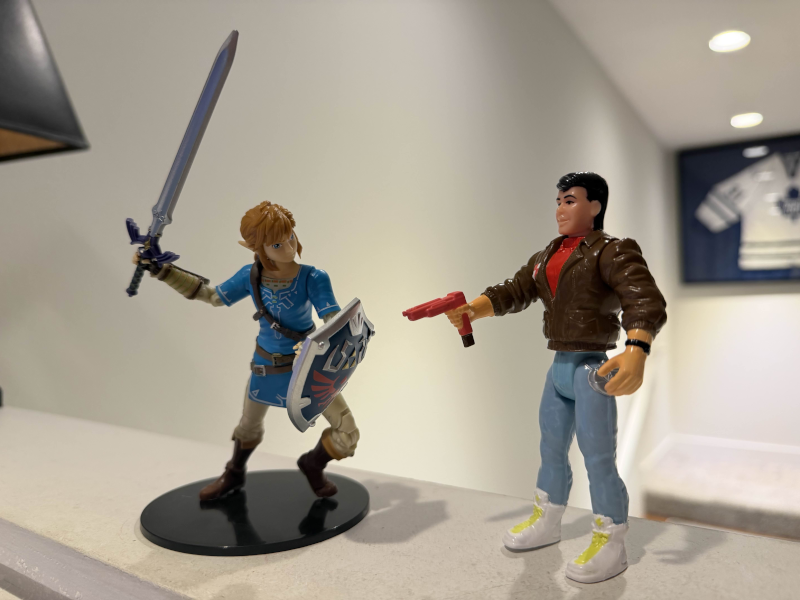
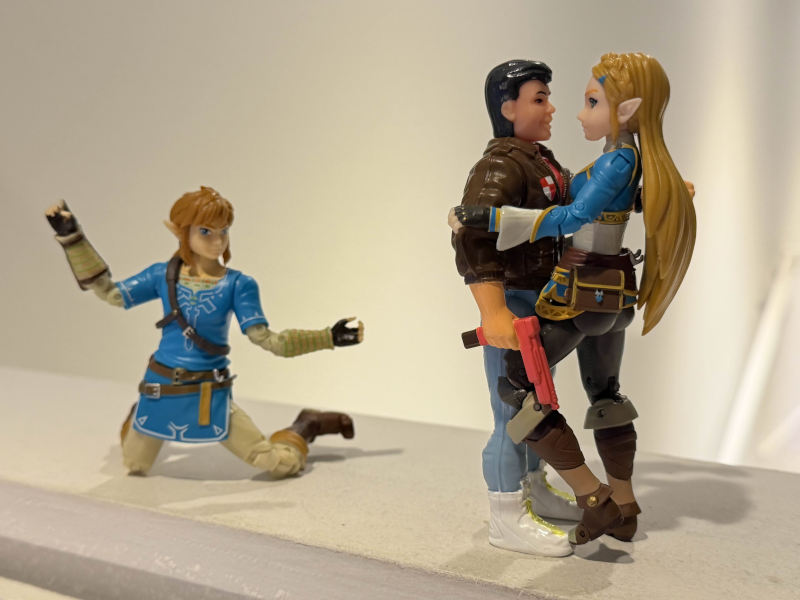
And Zelda's packing heat with a ray gun. :p
 
Last edited:

ZacWilliam1

Well-known member
Citizen
It looks good but...
It seems REALLY small to me for the price. Like this looks like something I'd expect to be $50 to $75.

-ZacWilliam, I know Lego are pricey, I buy a good amount of them. This just isn't a $130 dollar looking size to me.
 

Ungnome

Grand Empress of the Empire of One Square Foot.
Citizen
Yea, just looking at it and I'm trying to figure out how that's a 1000 piece set.
 

Caldwin

Banned for posting Metroid's flesh doors
Citizen
So you know those creepy red hands in Tears of the Kingdom. So...yeah, you go from: RUN AWAY, RUN AWAY. Then it's: Okay, I can do this, just gotta get the high Ground and get a good bead on them.

Then somehow, without you realizing it, you're at the point where you're on the ground, toe to toe...and bam! You freaking do it.

And you just take a step back and it's like...woah!
 

Sabrblade

Continuity Nutcase
Citizen
I got something cool to share with you all.

Last August on Zelda Universe, a user by the name of Shawn Yama went and built a website where people can compare and explore various different Zelda timelines that people have come up with.

Originally, Shawn uploaded five different timelines:
Of these timelines, I personally favor Lorulean's timeline, as evidenced by how, way back on Page 5, I once attempted to piece together the Zelda timeline in accordance with Lorulean's timeline.

HOWEVER, that was back before the release of Tears of the Kingdom (as well as Echoes of Wisdom and Age of Imprisonment), and while I still stand by a lot of what I said back then, I must admit that there were quite a lot of points I had made back then that have since become rather outdated (particularly, I was completely wrong about every guess I had made about TOTK as there was no way I or anyone could have ever predicted that TOTK Ganondorf would be a new guy instead of the same Ganondorf from TP that many people expected him to be).


But then, back in December, Shawn went and made an update to the website with a link to a web editor on StackBlitz that would actually enable people to create their own Zelda timelines to be submitted to Shawn via Google Form, which he can then add to the website.

And when I saw that he made this, while I am currently not a registered member of Zelda Universe (atm, I'm just a lurker), I just couldn't help myself and decided to create a brand-new Zelda timeline of my own making, one that pulls information from only the games themselves, their manuals, and the two Master Works books for BOTW (a.k.a. Creating a Champion) and TOTK.

My timeline features all of the following:
  • No hypothetical "what-if" branches, meaning no "What if Link dies?" like the Official timeline's Downfall branch or "What if Link fails to reach Vaati in time?" in Lorulean's Minish Cap Split. Everything that happens when the games are played properly to their proper conclusions are taken into account with no hypothesized alternate outcomes. The only splits utilized are the ones confirmed in-game: The Adult and Child splits in Ocarina of Time, and the one created by Terrako in Age of Calamity.
  • No reincarnating Ganondorfs, meaning in this timeline setup, the Ganondorf from Four Swords Adventures is the same Ganondorf as the one from Ocarina of Time, rather than some random reincarnation like in the Official timeline, while Ganondorf from Tears of the Kingdom and Age of Imprisonment is an entirely separate man with the same name, whom the other Ganondorf was simply named after and groomed by Koume and Kotake to be his successor (before he took his own life into his own hands to carry out his own ambitions independently of his namesake). And neither of these two Ganondorfs are themselves reincarnations of Demise, they are each just Demise's successors as Demon Kings; Demise was eradicated at the end of Skyward Sword. The so-called "curse" he declared at that game's end was more metaphorical than literal, as in the Japanese version he basically stated that his Demon Tribe would continue to harass those chosen by the gods for all time.
  • Four Swords Adventures as a direct sequel to Four Swords, as it strongly feels like it was originally intended to be, so the Link and Zelda of FSA are now the same Link and Zelda from FS.
  • Tri Force Heroes on the Adult timeline branch. That game has no business being a direct sequel to A Link Between Worlds. Despite its sharing NPC assets, those NPCs are all Hytopians, not Hylians/Hyruleans like the ones in ALBW. Nintendo's original statement of TFH being an ALBW sequel reeked of being a shameless, not-so-subtle advertisement for ALBW inside an advertisement for TFH.
  • Five spinoff games: BS The Legend of Zelda: Ancient Stone Tablets, Navi Trackers, and all three Hyrule Warriors games. Every other spinoff game I either couldn't see how they could possibly fit or just didn't see any point in trying to make them fit.
  • True Founding for King Rauru's Hyrule, taking him at his word of being Hyrule's first king, with his kingdom being established after Skyward Sword but before The Minish Cap.
  • And some minor retcons of my own making, to help smooth out the rougher edges. Nothing too egregious or absurd, though. I tried to keep all of these little retcons as reasonable and/or plausible as I could.


Here is MY timeline, the "Sabrblade" timeline. It is the longest one in terms of page length, and the densest one in terms of text descriptions, but I tried to keep everything as briefly summarized as I could.


Oh, and two other timelines were also submitted in the meantime:
  • The "Celeste" timeline, created by someone named Celeste (with no sources provided)
  • The "Founding Split" timeline, created by someone named Mana (with no sources provided), and this one is whole spider-web of a timeline that makes my lengthy timeline look subtle by comparison.

Shawn is also hoping that more people see this website he built and submit their own timelines to him for him to add to it, as so far it has only been myself, Celeste, and Mana who have made and submitted new timelines for him to add.
 
Last edited:

Sjogre

Active member
Citizen
I don't have a timeline to contribute, but I've heard a theory about the Downfall timeline that you might find interesting.

Namely, that the Downfall timeline isn't the result of the hero just lacking skill, but actually not having access to time travel. Without being able to travel back in time, pulling the Master Sword put him into an unwinnable scenario. This changes the Ocarina split into Adult, Child, and No Time Travel, which means that the splits all have to do with time travel instead of just taking a loss as canon.
 

Sabrblade

Continuity Nutcase
Citizen
I don't have a timeline to contribute, but I've heard a theory about the Downfall timeline that you might find interesting.

Namely, that the Downfall timeline isn't the result of the hero just lacking skill, but actually not having access to time travel. Without being able to travel back in time, pulling the Master Sword put him into an unwinnable scenario. This changes the Ocarina split into Adult, Child, and No Time Travel, which means that the splits all have to do with time travel instead of just taking a loss as canon.
I cannot wrap my head around how one would even think up such an idea when Sheik explains how the sword's mechanism of time travel works. The sword not being able to let Link return to the past "just because" feels like another one of those unsubstantiated what-if scenarios, as in, "What if the Master Sword couldn't return Link back in time?" But it could, that's the thing. Link needs to go back in time to at least complete the first half of the Spirit Temple. Otherwise, he wouldn't even be able to access Ganon's Castle.

This hypothetical scenario is proposing that the Downfall timeline would somehow come about from Link not being able to even start the final temple, forcing him to just give up his mission and let Ganondorf continue to rule Hyrule unopposed, but in which case the latter would never get sealed away due to the final Sage never being awoken, removing the last traces of connective tissue between OOT and the pre-game backstory of ALTTP that were barely there in the final game of OOT anyway.
 
Last edited:

Sjogre

Active member
Citizen
I cannot wrap my head around how one would even think up such an idea when Sheik explains how the sword's mechanism of time travel works. The sword not being able to let Link return to the past "just because" feels like another one of those unsubstantiated what-if scenarios, as in, "What if the Master Sword couldn't return Link back in time?" But it could, that's the thing. Link needs to go back in time to at least complete the first half of the Spirit Temple. Otherwise, he wouldn't even be able to access Ganon's Castle.
The Master Sword making Link go to the future is a random power pulled out of nowhere in the first place, so... Saying that it only works going forward doesn't make it more random. And no time travel means no time travel, so under this theory the Sword doesn't throw him forward, either.

I honestly do not remember what Sheik says about the Master Sword's time travel, so I'd appreciate it if you could repeat it here.

Not sure why you're assuming that the Hero would follow the events of the game so closely if there's such a big difference... After all, we know that the hero failing results in an army fighting Ganon instead.
This hypothetical scenario is proposing that the Downfall timeline would somehow come about from Link not being able to even start the final temple, forcing him to just give up his mission and let Ganondorf continue to rule Hyrule unopposed, but in which case the latter would never get sealed away due to the final Sage never being awoken, removing the last traces of connective tissue between OOT and the pre-game backstory of ALTTP that were barely there in the final game of OOT anyway.
Uh. Not sure if you miswrote or if I misunderstood, but per the official timeline, the sealing at the end of Ocarina doesn't happen in the Downfall timeline. I don't think that the downfall timeline was created to explain why A Link to the Past mentioned an Imprisoning War when Ocarina of Time didn't have anything that could really be called a war even if you turned your head and squinted, but it is an explanation.

Just for some background on what I'm talking about, here's the video I mentioned.

One of his points is that the Downfall timeline seems to be the "main" timeline of the series, which... Well, Nintendo does tend to treat it as more important than the other two. Which would make it really odd if it's the timeline caused by just failing, when time travel seems to be required to split a timeline.

I don't agree on TripleWario's specific theory,* but Ocarina's time travel has always struck me as weird on many different levels when I examined it, so tossing another theory at it can actually make it less strange.

*I honestly forgot that it was just that Link was healed before fighting Ganondorf. In my defense, Link was already at full health in the clip he showed.

Whenever I try to examine Ocarina's time travel, my first problem is that it looks like it made things worse. Leaving aside that most versions of Link, including this one, are presented as capable fighters even as children, zapping the Hero away meant that Ganon had seven years to attack things without Link even slowing him down. The next problem is that Link should have been a ten year old in a seventeen year old's body. Mentally, he hasn't had the chance to mature or gain experience, and physically... That teenage body was seemingly generated from thin air, raising the question of why the sword didn't just make him older without waiting seven years. Heck, why seven years? Is Link really that much better a fighter than at sixteen or eighteen?

So, my theory is that the Master Sword didn't have the power to send Link through time until Zelda used the Ocarina of Time to give it that power. In this version of events, Link pulls the Master Sword out as a child, and carries it off to learn how to fight with it. He spends the next seven years attempting to stop Ganon, but finally fails and dies. Zelda attempts to send him back in time to when he first pulls the Master Sword, but doesn't quite succeed. Rather, she sends the spirit of the sword back in time, along with her blessing. This also explains Link's teen body; it's the body he developed over those seven years of fighting Ganon.
 

Sabrblade

Continuity Nutcase
Citizen
The Master Sword making Link go to the future is a random power pulled out of nowhere in the first place, so... Saying that it only works going forward doesn't make it more random. And no time travel means no time travel, so under this theory the Sword doesn't throw him forward, either.
Link isn't physically transported to the future when he pulls the sword. He is put to sleep in a coma inside the Sacred Realm, hibernating for seven years.

I honestly do not remember what Sheik says about the Master Sword's time travel, so I'd appreciate it if you could repeat it here.
Sheik tells Link how to use the sword to return him back to the moment when he last pulled the sword from its pedestal seven years back:

"You destroyed the wicked creatures that haunted the temple and awakened the Sage... But there are still other Sages who need your help. In order to awaken all the other Sages, you must become even more powerful. You must travel over mountains... under water... and even through time... If you want to return to your original time, return the Master Sword to the Pedestal of Time. By doing this, you will travel back in time seven years.... The time will come when you will have to return here quickly... I will teach this to you for when that time comes... The song to return you to the Temple of Time... The Prelude of Light... As long as you hold the Ocarina of Time and the Master Sword, you hold time itself in your hands... Link, we shall meet again!"

And then later at the Spirit Temple, when Sheik tells Link he must return to being a child in order to enter the temple:

"Past, present, future... The Master Sword is a ship with which you can sail upstream and downstream through time's river... The port for that ship is in the Temple of Time... To restore the Desert Colossus and enter the Spirit Temple, you must travel back through time's flow... Listen to this Requiem of Spirit... This melody will lead a child back to the desert."

Not sure why you're assuming that the Hero would follow the events of the game so closely if there's such a big difference... After all, we know that the hero failing results in an army fighting Ganon instead.
The imaginary "Link fails" branch of the Downfall timeline is something that simply doesn't happen when the game is played correctly. It's a ridiculous notion.

Uh. Not sure if you miswrote or if I misunderstood, but per the official timeline, the sealing at the end of Ocarina doesn't happen in the Downfall timeline.
Yes it does. In Hyrule Historia's made-up scenario, the book says Ganon still gets sealed anyway even after Link loses, on Page 92:

"Ganondorf the thief obtained the Triforce of Power and managed to get his hands on Princess Zelda. The Hero of Time, Link, challenged him in a battle that would determine Hyrule’s very existence, and lost. At last, Ganondorf found himself in the possession of the Triforce of Wisdom that dwelt within Princess Zelda, and the Triforce of Courage that dwelt in Link. His true power achieved, he transformed into the Demon King. The Seven Sages of Hyrule, led by Princess Zelda, sealed Ganon and the Triforce in the Sacred Realm as a final resort."

Incidentally, setting aside the notion of Link losing, the text also says that Ganondorf only first became the Demon King upon acquring all three pieces of the Triforce after taking them from Link and Zelda following Link's defeat, when in the game itself, Ganondorf was already the Demon King upon first acquiring just the Triforce of Power. He is referred to as such all throughout the game in the Japanese version, with the English version changing his title to "King of Evil" or "Evil King" instead because Nintendo of America wasn't yet okay with using the word "demon", as the first game to properly use the "Demon King" title in English was Spirit Tracks.

I don't think that the downfall timeline was created to explain why A Link to the Past mentioned an Imprisoning War when Ocarina of Time didn't have anything that could really be called a war even if you turned your head and squinted, but it is an explanation.
When OOT was in development, an interview explained that it was supposed to tell the story of the Imprisoning War mentioned in ALTTP's backstory. However, OOT's events don't actually line up with the events described in ALTTP's Imprisoning War. There are broad-stroke similarities, yes, but the finer details don't align (particularly Ganondorf being sealed away with only the Triforce of Power at the end of OOT, while ALTTP is explicit that he is in possession all three pieces during the entire game and has been ever since he first set foot inside the Sacred Realm before the Imprisoning War). Then, TWW came along and took ALTTP's place as the direct follow-up to OOT's Adult ending, leaving ALTTP nowhere else to go but at some vague point after OOT's Child Ending, presumably some time long after MM. But then TP came along and followed on from MM and killed Ganondorf at the end, leaving everyone now wondering just how ALTTP was supposed to still connect to OOT if TWW followed on from the Adult Ending while MM and TP followed on from the Child Ending, when the game only has two branching endings.

MY fix for this in my timeline is that Ganondorf simply gets resurrected at some point after his death in TP and later goes on to ignite the Imprisoning War that leads into ALTTP, as his dying words in TP (moreso in the Japanese version) seem to imply that his demise in TP is not the end of him, that he is confident that he'll be back:

English: "Do not think this ends here... The history of light and shadow will be written in blood!"
Japanese: "Do not think it all ends here. Instead, think of this as the beginning of a history of a blood-drenched struggle between light and darkness!"

He knows something. He is far too confident for a man who is at death's door after having just been stabbed in the chest with the Master Sword. So, I choose to read this as Nintendo's subtle hinting that there is more of Ganon yet to come in spite of his apparent death in TP, that he will be back to carry out a long history of good vs. evil that had already been witnessed across ALTTP > OoX > LA > Zelda 1 > Zelda 2 at the time of the TP's release, and which would be further expanded upon with ALBW and EoW being added between LA and Zelda 1 (as mentioned in my previous post, I put TFH on the Adult branch after ST, so I don't count it as part of the main branch's history).

And as explained in my timeline, I propose that the Dark Rites performed by Koume and Kotake provide a plausible answer as to how Ganondorf gets resurrected between TP and ALTTP, as when the two witches perform them in OoX to revive Ganon from his death in ALTTP, the two are so confident that the ritual will work that it feels like they're really familiar with it, as though they have performed this ritual at least once before. So, if one plays TP and then ALTTP, one is naturally left wondering how Ganon is suddenly alive again in ALTTP after he just died in TP, only for OoX to provide a reasonable possibility for how he previously came back from his death in TP by showing how he comes back yet again from his death in ALTTP.

Just for some background on what I'm talking about, here's the video I mentioned.

One of his points is that the Downfall timeline seems to be the "main" timeline of the series, which... Well, Nintendo does tend to treat it as more important than the other two. Which would make it really odd if it's the timeline caused by just failing, when time travel seems to be required to split a timeline.

I don't agree on TripleWario's specific theory,* but Ocarina's time travel has always struck me as weird on many different levels when I examined it, so tossing another theory at it can actually make it less strange.

*I honestly forgot that it was just that Link was healed before fighting Ganondorf. In my defense, Link was already at full health in the clip he showed.
I've seen that video, yeah, and I honestly don't buy it since it's still relying on an imaginary hypothetical "what-if" scenario that never happens in OOT when the game is played correctly.

My intention was to avoid all diverging hypotheticals, to avoid all branching "what-if" paths, sticking only to how the events of each game unfold when played out to their proper natural conclusions. And in OOT, the game has only two conclusions that are proper and natural, the Adult and Child endings, which is what I tried to stick to without just making up more branching paths that don't actually exist in the game when played properly.

 
Last edited:

Sabrblade

Continuity Nutcase
Citizen


Top Bottom