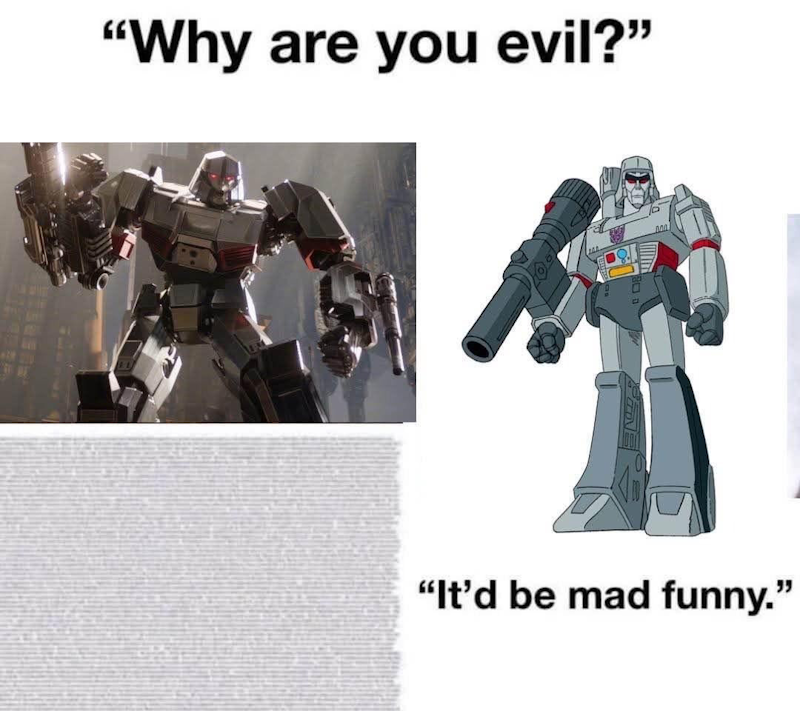
What strikes me about the Megatron face turn, though, is that it seemed to come at a time when beliefs seemed to be skewing more towards "there is good in everyone deep down," "evil for evil's sake is unrealistic," and "a great villain is the hero of their own story". And with the possible exception of that last one, in the years since... I'm not sure I feel that way anymore. Not as much as I once did.
Kind of strange, really.
As with all things, a trend in pop culture got popular and then it got overdone, there was burnout, and the previous way of doing things became retroactively appreciated more.
In this case, I think the tipping point in broader pop culture may have been the Disney Cruella de Vil movie, where the movie is so in love with the main character's sympathetic backstory that it can't bring itself to actually make her the villain who wants to skin puppies to make a coat. Which is... like... her thing. The character's name is "the cruel devil lady" and the movie was so lost in the sauce it went "she's not bad, really!" Just sort of caused a "what are we doing here?" reaction.
With Transformers, I've seen memes since TFO came out about how hard they leaned into making D-16/Megatron's motivations sympathetic that it pales in comparison to G1 Sunbow Megs doing it for the love of the game.
Now it's just a meme but it is indicative of how some people are viewing and taking this stuff.
A lot of it is also generational.
For most of us here, we grew up in the 80s and 90s where cartoon villains were snarling sociopaths who were evil just because. So when enough of us got old enough to write for these franchises and they were like "what if Snarly McMoustache had a sympathetic backstory and a reason to build the pollution factory?" the rest of us went "yes this is a refreshing change of pace."
But we're old now, man. Teens and young adults today grew up with increasingly sympathetic villains as the default and never had that 80s/90s experience that makes such writing seem new and insightful. To them this is just the standard, and your standard as a kid gets boring. They discover Snarly McMoustache being a prick just because and it's so different from what they're used to as the default they appreciate it.
Back to Transformers specifically... I think you CAN do a Megatron faceturn, it's just that IDW Megs was one of the worst to attempt it with.
Earthspark Megs works as a good guy because while there was a war, it's a kids show so the details are vague enough that you can tell yourself that this Megs didn't do any war crimes if you wanted to.
IDW Megs, however, spent over a decade being Space Hitler, and when he wasn't being Space Hitler, he was being Space Stalin. And you're going to give THAT guy a redemption arc? Please.
I've spoken before how uncomfortable that was for me personally, as someone with family who died in the Holocaust. IDW gave their Megatron his own version of Auschwitz, very clearly coded as Auschwitz, and then asked me to feel sorry for the guy? What?
But I don't think you need someone with my family history to actually appreciate the level of messed up that is, just conceptually. That so much time was spent trying to smooth the rocky gaps between early IDW's genocidal space tyrant and Roberts and Barber's owo softboy revolutionary kind of speaks to the problem there. If you need that much retroactive narrative massaging to make it work... it probably doesn't work.
Finally... I think a lot of this is a symptom of our inability as a society to appreciate nuance.
You can give a villain a sympathetic backstory. You can give them logical reasons that lead to them doing villainous things... but they can still be villains. Sure. Give Snarly McMoustache a sympathetic backstory and let us see what led to him opening the pollution factory... but he still opens the pollution factory. That we maybe sympathize with his early life situation and can see how he got here doesn't make him any less wrong. Lots of people do wrong things after starting from a sympathetic or understandable place.
We have socially, however, lost the ability to have nuance and so writers who opt for this path often fall in love with the sympathetic badguy and decide he's not so bad.
Rediscovering nuance as a broader society would do ourselves a lot of good in a lot of ways, but in terms of pop culture? It will at least help us to understand that we can have complex villains who are still ultimately villains.