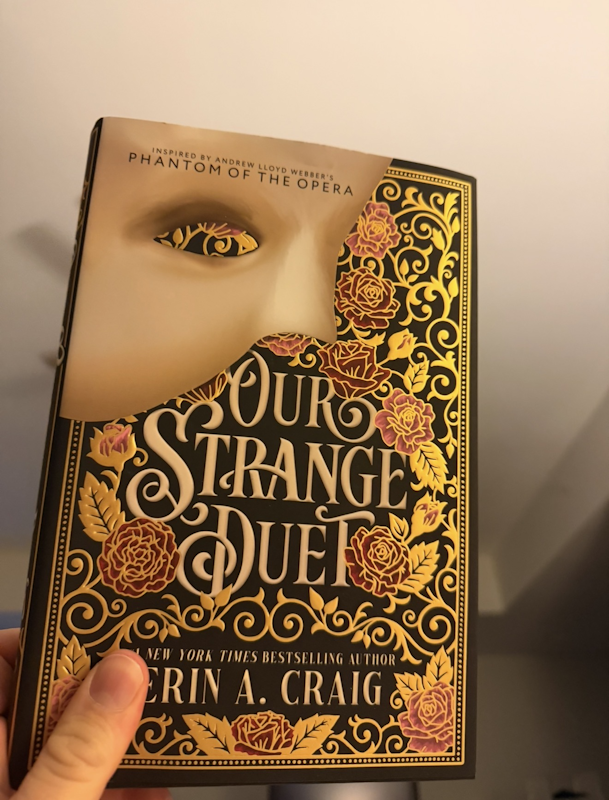
Books, novels, literature, what have you read lately?

Fero McPigletron

Feel the fear!
Citizen
(Side thing about Phantom of the Opera but I haven't seen any movie or read any adaptation but is there a reference to black flowers or only stems?

I read Discworld Terry Pratchett's Maskquerade and there was one paragraph that talked about finding black flowers and the person there didn't get it. I feel like it's a funny reference I missed.

Also the chocolate aphrodisiac scene had me actually scream laughing in a book. The timing and descriptions were amazing! Pratchett is genius)

There's a Dungeon Crawler Carl Free Comic Book Day comic that came out. If you got it, was it good?

I should get back to the current book. It's nearing the end, right? With the cookbook, Carl would be having all the plans set soon.
 

Rhinox

too old for this
Citizen
The webtoon isn't bad. Got the first graphic novel, which collects the webtoon. Stops in the first book just before the goblin massacre (iykyk)

As far as the plans . . . . . . kind of a lot has happened. Like, holy jive.
 

LordGigaIce

Another babka?
Citizen
Side thing about Phantom of the Opera but I haven't seen any movie or read any adaptation but is there a reference to black flowers or only stems?
There are a few references to flowers. When Erik (the Phantom) first takes Christine to his lair, she describes it as being full of flowers, like every flower shop in Paris had been bought out.
There's also a scene, where Raoul and Christine go to Christine's father's grave in the middle of winter. Raoul sees roses in full, vibrant bloom laid out on the grave, and the implication is that these out of season flowers are from Erik.

The ALW musical adapts this as Erik having a thing for gifting Christine roses. Sometimes they're black roses and sometimes they're red roses with black ribbons around the stem.
 

Fero McPigletron

Feel the fear!
Citizen
Ooooh. Hmm, I must have just been that, the gifting of flowers. I thought it was something about beheading or no head / face that I missed, from just stems.
 

CoffeeHorse

Hanging in there
Staff member
Council of Elders
Citizen
Seriously, the book is interesting.

One way Erik leans into the ghost thing is in leaving silent little "I was here" gestures. If you've ever had a legit ghost in your house, you know what that's about. AlW focused on roses, but there is so much more than that, and it's not just with Christine.
 

ZacWilliam1

Well-known member
Citizen
Latest Book Read: Magic the Gathering Strixhaven Omens of Chaos by Seanan McGuire.

Never read a MtG book before and havnt really played the game in decades but I've read and liked some of Seanan's other books and I saw her talking about how much she loved making this book and how she was hoping it would do well so they'd let her do more of them and so I gave it a shot. I liked it a lot. It's basically the first semester of a quartet of interplanetary misfits at magic college and they're fun characters in a cool setting. I would absolutely read a "Book 2."

-ZacWilliam, Next Up- The new Murderbot Diaries short novel. I have LOVED all of these so really looking forward to it.
 

LordGigaIce

Another babka?
Citizen
Seriously, the book is interesting.

One way Erik leans into the ghost thing is in leaving silent little "I was here" gestures. If you've ever had a legit ghost in your house, you know what that's about. AlW focused on roses, but there is so much more than that, and it's not just with Christine.
The virgin Edward watches his girlfriend sleep. The chad Erik watches his girlfriend's other boyfriend sleep.
 

Daith

I’m not dead yet!
Citizen
Latest Book Read: Magic the Gathering Strixhaven Omens of Chaos by Seanan McGuire.

Never read a MtG book before and havnt really played the game in decades but I've read and liked some of Seanan's other books and I saw her talking about how much she loved making this book and how she was hoping it would do well so they'd let her do more of them and so I gave it a shot. I liked it a lot. It's basically the first semester of a quartet of interplanetary misfits at magic college and they're fun characters in a cool setting. I would absolutely read a "Book 2."

-ZacWilliam, Next Up- The new Murderbot Diaries short novel. I have LOVED all of these so really looking forward to it.
I've thought about grabbing the Strixhaven book, but more just for the Command Tower card it comes with. It's been a minute since I picked up a MtG book. The hype of seeing Greg Weisman write the book for War of the Spark a few years back soured after realizing he juggles multiple characters better visually than in prose. And the subtle character assassination didn't help. Didn't bother with the second book afterwards.

I've slowly been working through Dungeon Crawler Carl. It's been a fun read. I'm a dozen chapters into The Butchers Masquerade. And damn I'm kinda wishing I had Mongo's luck right now :D
 

LordGigaIce

Another babka?
Citizen
I'm continuing on this to talk about one of my pet peeves in literature...

Sequels, Prequels, and Sidequels to The Phantom
of the Opera
I should love in concept but that I hate in practice because hackfrauds don't understand character work. I'm going to rant about three books.
The first is Susan Kay's 1990 book Phantom, a prequel to Gaston Leroux's 1911 The Phantom of the Opera that focuses on the early life of Erik, the Phantom.
The second is Sam Siciliano's 1994 The Angel of the Opera, a retelling of Leroux's original novel but this time Sherlock Holmes is there.
Finally, there's Fredrick Forsyth's The Phantom of Manhattan from 1999. This is the only one that's not related to Leroux's book. Instead it serves as a sequel to the ALW musical, and was endorsed by ALW as the official sequel to his show until he reworked it into Love Never Dies (we'll get to that atrocity).

Anyway 1990's Phantom by Susan Kay.

The premise behind this book is promising. It's specifically trying to be a companion to Leroux's novel, and Leroux provides just enough information about Erik's early life to serve as a guide but not so much to be restraining. There's room to tell a story, is what I'm saying.
Now often horror, fantasy, and sci fi franchises will land on a mysterious but popular race, character, monster, or idea and then ruin it by chasing the hype and over-explaining. So that is a risk with any story that attempts to explore Erik's life before becoming the titular Phantom of the Opera, but again... it's an idea that you can work with given what Leroux laid out back in 1911.

Kay stays true to that. She places Erik's birth just outside of Rouen, in the province of Normandy, France, in keeping with Leroux. She curiously doesn't give him a surname, odd given that she invents the name Nadir Khan for the Daroga later.
Erik's surname is never given in the book. It was "Claudin" in the 1943 movie (and 2026 Skybound Comics adaptation), and "Destler" in the 1989 movie that came out a year before this book. Still, she doesn't reveal a surname in her work.

Anyway Erik was born to a spoiled and entitled mother and a carpenter father who works for a circus. He was born in the year 1831, which places his birth in the reign of King Louis-Phillipe of France. This is noticeable because in the original novel Leroux states that one of the rooms in Erik's lair is called the "Louis-Phillipe Room" because it's styled in the fashion popular during Louis-Phillipe's reign. And he later says the furniture in it is all he has left of his mother. Kay paints Erik's mother as vain and spoiled who has to have the latest fashions, explaining why Erik specifically has his mother's furniture that matches high fashion during Louis-Phillipe's reign. His mother had to have the new hotness.

This same shallowness means she hates her son, since he was born with a deformed face, and didn't even bother naming him. The priest who Baptized him was forced to name him after himself. Which is a cute way of marrying that fact that every adaptation of Phantom treats "Erik" as his given name, but in the novel it's actually a name he assumed and claimed he came by it "by accident," and doesn't reveal his birth name. Here Kay merges them. "Erik" is his birth name and he came by it by accident. It's a clever idea. I hate this book but I will give credit where it's due, that's neat.

Anyway why do I hate this book? Well the fact that Kay felt the need to explain where Erik got his couch and dresser is a red flag. We're veering into the territory of untalented writers handling prequel material. "Just explain where all the things came from!" But alas I wouldn't hate this book if it was just that unoriginal. No, it gets worse.

Erik is described as a brilliant child despite the hatred he received from his mother and his utter uncaring indifference from his father. This isn't so bad, Erik is rather smart and clever and Leroux even celebrates his genius. Still it's a start of a problem with all three of these books, the constant glazing or Erik No Last Name Given (Except When it Is).
I like "Destler" myself, I just think it's striking as a name

Anyway Erik runs away from home at 9 and Kay more or less has him follow Leroux's backstory of joining a travelling fair of gypsies and displaying himself as The Living Corpse to make money. The gypsies' freak show Erik is a part of is run by a Frenchman named Javert, heavily implied to be the father of Inspector Javert from Les Mis. This is more of Kay falling into hack territory because what does that add? Les Mis is about the failed revolution against King Louis-Phillipe so I mean... sure... if you wanted to tie Phantom and Les Mis together you could... but why?
Anyway Javert Sr is an asshole even by shady freakshow manager standards and tries to rape Erik at the age of 12 but he kills him and flees. Kay gives Erik a stopover in Rome and has him apprentice with a stonemason named Giovanni for three years before he has to flee again when he accidentally kills Luciana, Giovanni's daughter.

This leads to Erik ending up at a circus in Russia. It's here he's found by Nadir Khan, the Daroga of the Imperial Persian court and a cousin of the Shah. The Shah has heard of Erik from traders and travellers and wants him as an exhibit in his court.
Nadir is the Persian, or the Daroga, a character from Leroux's novel who sadly gets adapted out of most adaptations. Giving the Persian a proper name is the single best thing Kay does with the novel because the rest of Erik's time in Persia is a nightmare.

Erik, as a character, was pretty accurately described by @CoffeeHorse on the AllSpark Discord (check it out) as the first modern supervillain. He's got a cape, a mask, a sympathetic backstory, and a doomsday plan to blow up half the city.
This makes Erik cool, as far as fictional antagonists go. He's got style. He's got, as Megamind said, presentation. Sadly this leads to writers after Leroux hardcore identifying him and forgetting that he's kind of a mass murdering psycho who emotionally and psychologically manipulated a woman grieving for the loss of her father to try and force her to marry him under threat of city destroying explosion. Small things, ya know? And the truly untalented writers identify with Erik and then project their own beliefs onto him. And Susan Kay is, sadly, not very talented.

Orientalist attitudes were rife in French culture when Gaston Leroux wrote The Phantom of the Opera, and Leroux was deeply aware of this and critical of it. The whole character of the Persian (for all of Kay's faults, "Nadir Khan" works as a proper name for him) is a subversion of the "mysterious Jew or Arab or other Oriental who knows the villain and is shady." Leroux plays it straight until the Persian enters the narrative and reveals he's actually a stand up guy who's tracking Erik, because he's known him for years and is trying to subvert a disaster he knows is coming. Leroux even says that the Persian's heroism and moral uprightness is beyond dispute.

Kay, however, seemed to mistake the Orientalist attitude Leroux was playing with and subverting by... playing it straight. Thankfully she doesn't reduce Nadir to an evil caricature, she keeps his heroic qualities intact. Still, she uses Erik's time in Persia to decry Persia as a backwards, barbaric, dirty place with no worthwhile culture. It would be one thing if Erik embodied some of these haughty European attitudes and learned to get over them as he was exposed to Persian culture, but no. Kay has Erik through first person narration call Persian architecture trash, the cities dirty, and the people stupid and superstitious. Keep in mind Erik was last in Russia before arriving in Persia and in no way is 19th century Russia a nicer place than 19th century Persia. Kay indulges in some odd ethnic stereotyping by claiming Persians worship cats (what?!?!) and other random nonsensical bs that reads like it came from a racist travel log. Only Kay has Nadir by Erik's side going "yep my homeland sure does suck" every time Erik observes something like this.
The apex of this nonsense, however, is when Kay uses Erik to go on a tirade about how barbaric it is that Persia at the time saw widespread practice of arranged marriages. And... oh man. What the flying hell?

First... yes, 19th century Persia did see widespread acceptance of arranged marriages, but so did most countries in the Old World. Hell, it was common in certain social classes in Erik's native France.

Secondly Erik "I don't like inquisitive women" Destler, Erik "marry me Christine or I'll blow up the city" Destler, is who Susan Kay is going to use as her avatar to go on a modern feminist lecture about how arranged marriages in the 19th century were wrong?

Look! I'm not saying the sentiment is wrong, but I do think cheery-picking it to exclusively trash Persian culture is weird as hell, and more importantly from a character writing perspective?
The Phantom of the G-ddamned Opera, a character whose whole thing is trying to force a woman to marry him, isn't the character you should be giving the impassioned moral stand against coerced marriage to, Susan! Good G-d.

This is what happens when hacks fall in love with a character they didn't actually create... they end up imprinting on him and forget he's the villain of the whole thing. Sadly this will happen more times
through these three books.

Anyway Erik's time in Persia follows Leroux's once Kay got hating on Persia out of her system. He designs an elaborate palace for the Shah, and entertains his wife with devious tricks and torture devices because she's sick like that. The Shah, fearing that Erik will tell others about the secrets of the palace he designed for him, orders Nadir to kill him. Nadir feels this is unjust and lets Erik escape, where he flees back to France and settles in the underground catacombs beneath the Opera.

I'm Jewish but all I can say is Jesus f'ing Christ.

Continued in part 2....
 
Last edited:

LordGigaIce

Another babka?
Citizen
part 2... 1994's The Angel of the Opera by Sam Siciliano.

Like Kay's Phantom, I should like this. It's a re-telling of Gaston Leroux's original book but with the added caveat of Sherlock Holmes being in the middle to investigate the strange affair of the Phantom of the Opera, a mystery never fully explained.

I like Sherlock Holmes a lot. Both the original ACD novels and more modern novels which continue in Doyle's style to tell "continuing adventures." Holmes is a blast. And the timeline is close though that "Sherlock Holmes investigates the Phantom of the Opera" does work as a premise. AND there are a lot of promising dynamics. Holmes and the Persian. Watson and the Persian. Holmes and Erik. Raoul and Watson. There's some meat here. Some potential. Let's talk about how Sam butt-fumbles that like he's the New York Jets.

The book wastes no time in dashing any expectation you might have of this being a good time. Before we even get to the prologue, we have an introduction. Written by Dr. Henry Vernier.

Who is Dr. Henry Vernier? Good question. He's Sam Siciliano's self insert OC. And he (and therefore Sam) HATES John Watson. And this intro will lay out the first big problem. Dr. Henry Vernier replaces John Watson in this narrative, both in the role of narrator and as Holmes's sidekick. He's presented as Holmes' cousin and lays out that John Watson was a stuffy upper middle class knob who Holmes always hated, and who was a sensationalist and a liar and a cad. Watson, according to Vernier, lied when he described Sherlock Holmes as being a supporter of Britain's imperial colonial endeavours, and lied when he called Holmes a Christian. Vernier will have us all know Holmes hated imperialism and colonialism and was a staunch atheist.

Now the problem here is that in ACD's original stories... Holmes is a Christian. And while he's eccentric and out of step with wider British society, he does believe in the British Empire. This isn't a matter of interpretation. It's just what's in the text.

Siciliano creating an OC version of Watson to paint Holmes as an entirely different character is just absurd to me. If you're going to trash Holmes' traditional sidekick and replace him with your own author avatar, and if you're going to reinvent Sherlock Holmes so fundamentally... just make up an entirely new detective character.

The kicker is that Dr. Henry Vernier is basically just John Watson in every way that matters. His friendship with Holmes is the same. His dynamic as an investigator is the same. If you ignore the various random insults thrown Watson's way (who never even appears in this book in person) you could mentally substitute "Henry Vernier" for "John Watson" and nothing changes. It's a case where Siciliano should have either created an original pair of detective characters for this, or just tried to stay accurate to the legacy characters whose popularity he was riding.

hug, I haven't even gotten to the Phantom stuff yet.

Well Siciliano uses Leroux's narrative as the basis, just working in Holmes and Watson Vernier as needed.

Armand Moncharmin and Firmin Richard, the new managers of the Paris Opera, hire Sherlock Holmes to investigate the strange affair of the Phantom of the Opera, a mystery never fully explained.
Holmes enlists the author's self insert OC... I mean his cousin Dr. Henry Vernier, for help.

It starts off well enough, my annoyances about the Watson situation aside (that you can just mentally assume Vernier is Watson and nothing changes helps). Moncharmin and Richard have always been comedic characters out of their depth, so their exasperation as they relay the happenings related to the Phantom and some background on Comte Philippe de Chagny, his younger brother Raoul, the Vicomte, and the young Swedish opera soprano Christine Daaè who Raoul and the Phantom each seem to have an attachment to is fitting. Holmes fleecing them for more than double his usual rate because he knows they're desperate works, and all in all this is a decent setup to the premise.

What follows, however, is Siciliano deciding that every character from The Phantom of the Opera not named Erik sucks and you should hate them.

We start with Comte Phillipe de Chagny. One of France's richest men, and head of a noble house that dates back to the late medieval period. I was excited to see Phillipe. He's a great character and most adaptions leave him out entirely. Sadly, Siciliano has decided that he's just going to be a snarling, cold hearted aristocrat who more or less just calls Holmes and Watson Vernier peasants to their faces. His big concern is that his younger brother Raoul will try to marry Christine Daaé, which would be beneath his station. Thankfully we have Totally Original OC (Do Not Steal) Henry Vernier and the New and No Longer Imperialist Sherlock Holmes to let us know what an upper class asshole he's being.

Thing is that book Phillipe was a flawed character and his flaws did come from the class he belonged to. Leroux was not afraid to interrogate that, and by having Raoul stand up to his brother and then leave his world behind to give up everything and be with Christine is a sign that Leroux was making a point about how foolishness inherent in the biases of the upper class.
But at the same time... Phillipe was a kind man despite his blind spots who took it on himself to raise his younger brother when their dad died, and genuinely loves him and tries to do what's best for him.
Phillipe has layers, is what I'm saying. He's flawed, but a good guy. A good guy, but also an upper class knob. Siciliano reducing him down to a caricature of himself is a letdown.

Raoul doesn't fair better. Raoul is shown to be an excitable, headstrong moron who's one second away from a hissy fit at any moment. While Raoul in the original novel could be bull headed and impulsive, he was also deeply rational (he sees the red flags around Christine before anyone else and sees through Erik's Angel of Music act instantly), loving, and kind. And being that he and Christine are only 21 at the time of the novel, his impulsiveness makes sense. But that kindness and rationality is stripped away and Raoul suffers a fate like his brother, reduced to his most base negative traits.
Oh, Siciliano keeps harping on Raoul being effeminate and this clearly means he's unworthy of Christine. Which is... yikes.

Christine also suffers. Siciliano does offer a nice touch by pointing out she speaks French with a slight Swedish accent... so points for remembering she's Swedish (I mean that, a lot of people forget that).
But whereas Christine in the book was loved by most of the opera for taking time to know everyone who worked there, and offer to help them in their tasks when she could, this Christine is a backbiting people pushing diva. Siciliano was committed to following the bones of Leroux's plot and so Christine had to end up with Raoul, and since Siciliano is here to stan for Erik this means ultimately she and Raoul have to be unlikeable.

Finally the Persian. The heroic Daroga who risks his life to help Raoul save Christine after Erik abducts her is now recast as an evil, self serving charlatan who leers at the white ballet dancers openly. WHY. Just... WHY, SAM?

Which you know... sucks? I like The Phantom of the Opera and its characters. Sure, Erik is cool and mysterious, but Christine is whimsical and kind. Raoul is sweet, loving, and selfless. Phillipe is a bit of a rich snob, but he loves his brother and wants to do right by him. The Persian is bright and determined and heroic.
So why are all of these characters now just unlikeable schmucks?

Erik, is of course, the exception. Like Kay, Siciliano has gone full crush on Erik, who develops a bromance rivalry with Holmes. And seeing as Holmes has been reinvented to be Siciliano's secondary author avatar... well... yeah.

Erik is a beleaguered, misunderstood genius, Holmes' intellectual equal, and the two spend their time after they meet trading quotes from classic literature at each other and just all around impressing each other.

Thing is, I could see Sherlock and Erik having a sort of mutual respect for each other in a crossover that was done well. That in and of itself is fine... but when it comes at the expense of making everyone else shallow and unlikeable? It's grating. Erik is, after all, responsible for a large number of murders. Can we stop pretending he's the Most Special Boy Who Never Did Anything Wrong?

concluded in part 3...
 

LordGigaIce

Another babka?
Citizen
... part 3, 1999's The Phantom of Manhattan by Fredrick Forsyth Or Why Didn't Andrew Go to Therapy After the Divorce?

This is a bit of a change of pace. Both Phantom and The Angel of the Opera work within the confines of Leroux's 1911 book. This, however, is a sequel to the Andrew Lloyd Webber musical. That's an important distinction. While the ALW musical is one of the more faithful adaptations of the book, it's not a 1:1 adaptation, and one change is Erik's fate.
In the book, he lets Christine and Raoul go from his lair. Raoul gives up his wealth and title to go marry Christine and live as a peasant in obscurity in her native Sweden. Erik, meanwhile, dies of a broken heart after reconciling with the Persian, the closest thing he has to a friend.
In the musical, Erik lets Christine and Raoul go, they marry and she becomes the Vicomtess de Chagny (the show isn't interested in exploring and interrogating class like the book is) and Erik lives, but vanishes into the night to escape the angry mob that's come looking for him (on account of all the murders).

So because Erik lives... you could do a sequel with him that you couldn't do if you were stuck following Leroux's narrative. That was what Fredrick Forsyth had in mind, when he had lunch with Andrew Lloyd Webber and kicked around the idea of a story where Erik would flee France and come to America after the events of the ALW musical.
ALW endorsed the book as his show's official sequel until he reworked its elements into Love Never Dies, but more on that later.

The Phantom of Manhattan picks up in Paris in the early 1900s. Antoinette Giry, the former head of the Paris Opera's ballet corps, is on her death bed. She's called for a lawyer to tend to one final piece of business before she dies.
She explains that when she was a ballerina a gypsy fair came through Paris. One exhibit was a deformed boy who was beaten and shown off to a jeering crowd. She couldn't stop feeling sorry for this boy and went back one night to secretly break him out.

She hid him at her home at first, and learned his name was Erik Muhlheim (Forsyth has opted to give Erik a new surname) and he'd been sold to the fair as a young boy because his mother had been ashamed of his deformed face. Antoinette takes care of him, but she has a young daughter named Meg and it's not feasible for Erik to stay with her. So she secretly moves him into the catacombs beneath the Paris Opera where he was free to set up a home for himself. Over time he taught himself music, architecture, and magic/illusions. Antoinette eventually becomes head of the ballet corps and Erik discovers Christian Daaè. Christine's kind heart, her untapped potential as a singer, and her grief over her recently deceased father all endear her to Erik, who becomes obsessed.

The lawyer interrupts Antoinette. He's putting 2 and 2 together. Is this deformed man the infamous Phantom of the Opera who made headlines years and years ago?

Antoinette says it is. The lawyer muses about how he did kill a lot of people and Antoinette says he didn't.

Oh no.

No, she says that Joseph Bouquet (whose death at the hands of the Phantom is sort of a canon event in the Phantomverse) was a sad drunk who hung himself and it was merely blamed on the Phantom. The chandelier crash? Due to poor maintenance. The only death from the ALW musical that Forsyth allows to be tied to Erik is the death of the singer Ubaldo Piangi. Antoinette says Erik just meant to knock him out but Piangi was so fat he choked on his own spit.


Once again the author fell in love with Erik. But hell... even Kay and Siciliano didn't go so far as to pretend the murders of the Phantom of the Opera weren't done by the Phantom of the Opera.

I LIKE Erik. He's a cool villain... but if we're just going to do this... what's the point?

Anyway the rest of the intro is Madame Giry telling the lawyer that after the events of the ALW musical Erik came to her desperate, and she helped him stow away on a boat bound to America. We also find out that Christine married Raoul, took his noble title, became a famous opera singer, and they had a son named Pierre.

Madame Giry uses what's left of her savings to pay the lawyer to take a secret letter to America and give it to Erik, because she's sure he's still alive.

We then cut to Erik, in the first person. He explains how he came to America, washed up on shore in Coney Island, and using his intellect, managed to build a business empire on the resort based around carnival games. Still, he needed a front man on account of his facial situation so he teamed up with a Maltese immigrant named Darius who was on the run from the law in Europe for killing a priest.

Erik explains that through Darius he used his money made on Coney Island to play the stock market and he ended up as the shadowy puppet master behind one of the largest corporations in New York City.

And you know what? I don't mind that. Erik, be it in the book or the ALW show, is shown to be genuinely brilliant and sharp. I can buy that, in a less stratified society like early 20th century America (compared to France of the same period) he would make himself rich.

It's the pairing of this with "also he never hurt anyone all of those deaths were misunderstandings" that pushes it into the realm of ridiculousness. STOP TRYING TO MAKE THE PHANTOM OF THE OPERA AN OWO SOFTBOY!

Anyway Erik explains that he's still in love with Christine but he's let it go and he's trying to move on. He even resigns to never having another love in his life and promises Darius will inherit everything when he dies.

Also Darius is literally in league with the Devil, who talks to him in opium dens and tells him to wait and kill Erik to take his wealth when the time is right.

What even is this book?

Well one day the French lawyer shows up and manages to deliver the letter from Madame Giry to Erik's company, and he gets it.

The letter explains that years and years ago, Antoinette Giry was mugged outside of the Paris Opera House and a brave boy broke it up. But, the robber's gun went off and severed a blood vessel in the boy's groin. The boy was Raoul, the Vicomte de Chagny, and because of the wound he'd never be able to perform sexually. This happened years before the events of the musical so Antoinette knows... Pierre de Chagny is Erik's son, and she had to tell Erik about it before she died.

Erik confirms through inner monologue that, between him abducting Christine during the opening night of Don Juan Triumphant and Raoul reaching the underground lair to save Christine, Christine and Erik slept together. And that's how Pierre was conceived. Erik didn't know that though, and didn't know Raoul was impotent until just now and had always assumed Pierre was Raoul's.

Now that Erik knows he has a son his obsession with Christine is reignited and he funds the building of an opera house in New York and uses a frontman to hire Christine to sing on opening night. Once in New York Christine meets Erik in a house of mirrors in Coney Island, and she admits Pierre is his. Christine says he's nearly 13. If Erik can wait just five more years, she'll tell Pierre about his parentage and if Pierre wants to seek him out then he can. Erik agrees.

But Darius, through opium addiction and possibly Satanic influence, finds out that Pierre is Erik's kid and plots to kill him, fearing his status as Erik's heir is threatened.

Lots of melodrama, Darius tries to shoot Pierre, Christine takes the bullet and dies, Raoul tells Pierre who his father is, and Pierre leaves the man who has been a supportive and loving father to him all his life and decides to live the rest of his life with Erik.

Umhm.

You might see an issue with the ending. Raoul just getting dumped by what is essentially his own kid who he raised after his wife was shot by his wife's former stalker's unhinged assistant is kind of stupid.

Still, despite being rendered a eunuch and losing his entire family in one afternoon, Raoul isn't entirely shat on. He's still presented as a kind man and good father. Which makes the ending kind of a wtf? ass pull.

Good thing we have Love Never Dies to fix it!

ALW immediately began working on adapting The Phantom of Manhattan into a musical sequel to his version of The Phantom of the Opera. His cat stepped on the digital piano he was recording the score to and it deleted the whole thing but alas Andrew didn't listen to this clear sign from a just and loving G-d.

Love Never Dies reworks TPoM in a few ways. Raoul is no longer impotent but the parentage of Pierre Gustave is still debated because of the coerced sex (yay....😐). Darius is replaced with Meg Giry, Christine's BFF from TPotO, as the villain because I guess we need to assassinate more likeable characters.
And Raoul may have gotten a working penis back, but he lost his dignity. See, ALW seemed to recognize that the ending of TPoM made no sense. Even if Pierre knew Erik was his biological father, he gave up on a kind and loving man who raised him for 13 years way too easily. So now Raoul is a drunk and gambling addict who lost most of his family wealth betting it away and he's a cold, and angry father figure to Gustave.

Excuse me while I punch the sky.

Things mostly play out the same as the Forsyth book... but the thing to keep in mind is...

... all of this may be because Andrew didn't take the divorce well.

When ALW wrote The Phantom of the Opera musical in the 80s, he was married to a singer named Sarah Brightman. Sarah was cast Christine and the musical went on to be a huge hit.
And it's telling that in TPotO musical Raoul comes off very well with a lot of his best book traits intact. Maybe because ALW, the aristocratic musical composer married to Sarah Brightman, felt a sense of kinship with Raoul, the aristocrat who ends up marrying the singer Christine Daaé.

Sarah and ALW divorced in the early 90s though, and it's hard not to read the general direction of LND as ALW coping badly, now identifying with the shunned musical genius and writing a show about how wrong it was for Sarah Christine to leave him Erik.

But that's just a theory.

Either way you cut it, The Phantom of Manhattan and LND both embody the issues with the works I've ranted about.

Love for Erik to the point that the authors forget he's a villain, and the tearing down of layered and fun characters in pursuit of glazing Erik nonstop, and thus missing the point of the original story.

We should feel sorry for Erik. We should pity him, but we shouldn't forget that he's a villain.

Perhaps the first supervillain.

 

CoffeeHorse

Hanging in there
Staff member
Council of Elders
Citizen
The book wastes no time in dashing any expectation you might have of this being a good time.

You are a far better writer than any of these hacks.


Jive like this is one reason I appreciate the 2004 film. At least Butler understood he was playing a cape-twirling villain, and happily leaned into it at every sensible opportunity.

Something he does not get enough credit for is he actually played the role two ways. His body language is completely different when unmasked. Masked Erik is slick. Even when he's in murder mode he's still smooth about it. Unmasked Erik is a powder keg. The mask is off in every sense. It is obviously dangerous to be anywhere near him.


Top Bottom