
You are using an out of date browser. It may not display this or other websites correctly.
You should upgrade or use an alternative browser.
You should upgrade or use an alternative browser.
Israeli-Palestinian Conflict
- Thread starter Teufel
- Start date

I don't get this. Even if Israel had proof of Hamas or Islamic Jihad infiltrating these groups they're currently in 100% occupation of the Gaza Strip. Why not let these groups operate in Gaza, catch them red handed, and go to the press with the proof?


If you think this is full Nazi, as a Jew I'd happily trade. Oh, you wouldn't? Curious.
Here is a good backgrounder on the unprofessional and dishonest behavior of Doctors Without Borders regarding Palestine in general and post-10/7 in particular. Tl,dr: they openly say Israel should cease to exist, refused to investigate Hamas crimes, continued promoting the Al-Ahli hospital bombing hoax long after it was exposed, and had Islamic Jihad terrorists working for them masquerading as "doctors." Why do they deserve any more respect than Mother Theresa after her sketchiness was exposed?
Here is a good backgrounder on the unprofessional and dishonest behavior of Doctors Without Borders regarding Palestine in general and post-10/7 in particular. Tl,dr: they openly say Israel should cease to exist, refused to investigate Hamas crimes, continued promoting the Al-Ahli hospital bombing hoax long after it was exposed, and had Islamic Jihad terrorists working for them masquerading as "doctors." Why do they deserve any more respect than Mother Theresa after her sketchiness was exposed?
Rasha Khoury, the president of the board of Doctors Without Borders USA and a surgeon who has worked courageously in war zones, might be seen as the embodiment of this new tendency in the human-rights establishment. She was born in the occupied Palestinian territories. A month after the Hamas attack and the beginning of the Israeli counterattack, she posted an essay on the organization’s digital bulletin board, known as the Souk, the Arabic word for “market.” “We must decolonize our minds,” she wrote. “The mainstream discourse around the unhinged bombardment and massacre of Palestinians in Gaza by Israeli forces for the last 33 days continues to affirm the colonizer’s world view, one rooted in white supremacist logic.”
Not long after October 7, Khoury was among the co-authors of “Violence in Palestine Demands Immediate Resolution of Its Settler Colonial Root Causes”—an article in the journal BMJ Global Healththat, subsequent commentators argued, ignored Hamas’s role in triggering the Israeli invasion and incorrectly blamed the Jewish state for a deadly missile strike. In a follow-up article, Khoury and her co-authors responded to the criticism with scorn. “Demands for ‘corrections,’” they declared, “are almost always demands to acquiesce to Israeli state propaganda.”
Doctors Without Borders seemed to minimize the egregiousness of the Hamas attack from the start, describing it on X that very day as “the escalation between Israel and Gaza.”
On October 17, 2023, the Hamas-run Gaza Health Ministry reported that Israel had bombed the Al-Ahli Arab Hospital and killed close to 500 Palestinians. Amnesty and Doctors Without Borders immediately picked up on that claim: The leaders of the latter group posted about the Israeli “massacre” on their social-media feeds.
To this day, Doctors Without Borders has not removed its debunked claims of Israeli malfeasance from its social-media feed.
Doug Sandok worked with Doctors Without Borders in Rwanda, Chechnya, and Sri Lanka in the 1990s. He has charted the curdling of the group’s rhetoric regarding Israel. “I went to an organization-wide meeting in November 2023, and the discourse shocked me, all about anti-settler-colonialism and racism,” he told me. “A number of us asked, ‘Is it really a foregone conclusion that Israel has committed genocide?’ It feels like one more institution captured by the ideological left.”
This past fall, on the anniversary of the October 7 attack, an extraordinary anonymous statement purporting to represent more than 40 current and former Doctors Without Borders staffers appeared on the Souk. It angrily protested how the Geneva-based organization, which has 69,000 employees and an annual budget well over $1 billion, tended to characterize the conflict between Israel and Hamas. The statement accused Doctors Without Borders of remaining silent about Hamas’s “ferocious barbarity” and sexual violence and of ignoring Israelis taken hostage, some of whom died in captivity, including infants. “This version” of the organization, the statement declared, “does not represent us. It barely represents itself.”
French physicians founded Doctors Without Borders in the aftermath of a civil war and famine in Nigeria. Its charter committed to providing medical care without regard to politics, race, or nationality. But five staffers, all of whom spoke on condition of anonymity for fear of endangering their jobs, described an environment in which their colleagues refused to entertain any nuance about the Jewish state. In November, for example, Javid Abdelmoneim, the former president of Doctors Without Borders UK, endorsed a full boycott of Israel, writing on X: “Invest no other time on Israel other than to cut it out of your life.”
Michael Goldfarb, a former longtime communications director for Doctors Without Borders, had worked in desolate and dangerous corners of the world. But his patience for his former employer eventually reached an end. He posted last year on the Souk, writing of his frustration with the “blatantly hate filled and, yes, anti-Semitic responses” within the organization to the anonymous Souk statement. “Fear of retaliation, silencing, and ostracism grips many MSF colleagues,” he wrote, using the French abbreviation for Doctors Without Borders, “who nonetheless courageously endorsed the publication of the post.” (Goldfarb declined my request for further comment.)
As if to underline his statement about organizational intolerance, Doctors Without Borders employees let loose on the Souk, going after Goldfarb and all those who signed the statement. “I leave you with your hatred, your racism and your victimization (We’re used to it!),” one rank-and-file staffer wrote. Another employee, Olivier Falhun, of the press office in Paris, responded to the dissenters, “At the risk of offending your principles-based catechism, I can’t resist sharing with you a self-evident solution … ‘We’ll have to give the land back. It’s as simple as that.’”
These and similar statements have remained on the organization-wide site for many months. (I sought to talk with senior leaders at Doctors Without Borders USA about this atmosphere and other questions regarding Israel. A press officer, Brienne Prusak, wrote back that “we are respectfully going to decline.”)
The organization’s one-sided view of the Israeli-Palestinian conflict goes beyond incendiary sentiments on message boards and social media. The fact is that the hospitals they worked in were often home to Hamas gunmen and armaments.
In November 2023, the Israeli army announced plans to root out Hamas operatives that it said were hiding in Al-Shifa Hospital, a major medical facility in Gaza City. A large contingent of Doctors Without Borders staff worked there, and its leaders took offense at the Israeli claim. The president of its Australian chapter, Katrina Penney, told a newspaper that she had “seen no evidence that the hospital buildings or the compounds are being used by Hamas as a military base.”
I asked two Doctors Without Borders employees who had worked in East Jerusalem and Gaza about such claims. These staffers frowned. The presence of Hamas gunmen in that hospital and in others was an open secret. “You knew Hamas was there; I went to meetings where this was made very clear,” the staffer, who asked for anonymity out of a desire to continue to work in the human-rights field, told me. “Doors were hidden. There were units you did not get into, that had armed guards at the door.”
Laws of war require soldiers to act with great care when fighting around hospitals, and none of this testimony would justify Israeli brutality. Likewise, however, humanitarian groups such as Doctors Without Borders claim to observe the principle of bearing witness to abuses—an obligation that includes challenging armed groups such as Hamas that risk civilian lives by using hospitals as bases and hiding spots.
Months after that Israeli operation at Al-Shifa, Hamas’s subterfuge was exposed—as was the willful ignorance of Doctors Without Borders. A New York Times investigation strongly suggested that Hamas used Al-Shifa for cover and to store weapons. U.S. spy agencies went further, saying that Hamas used Al-Shifa as a command center and that it held hostages there. That would be a war crime.
Last June, Doctors Without Borders accused Israel of killing one of its staff physiotherapists, Fadi Al-Wadiya, as he biked to work. Organization officials portrayed this as a war crime, an innocent family man slaughtered. An official statement said, “There is no justification for this; it is unacceptable.”
Doctors Without Borders posted a photo of Al-Wadiya’s fractured bicycle. Word circulated that he had been a fighter with Islamic Jihad, a radical group that allied with Hamas on October 7. The organization vigorously denied this. Then the Israeli army released photos of Al-Wadiya, who it said was a rocket specialist, wearing an Islamic Jihad uniform. Doctors Without Borders ultimately conceded that it was “deeply concerned by these allegations” and said it would “never knowingly employ” a fighter.
A staffer involved in hiring for Doctors Without Borders spoke of great organizational pressure to expand hiring in Gaza. “We were told not to check backgrounds,” this employee told me, adding that one office in Gaza had two known Hamas militants. “Our Arab staff was greatly concerned because to be in the same room with operatives put all at risk.”
This staffer paused. “Look, I’m truly not defending Israel; there is a lot in its actions to criticize,” this person said, adding that Doctors Without Borders had been “blindly pro-Palestinian to an extent that was destructive. And if you were Jewish and questioned it, you were just waved off.”
Last edited:

Calling the current regime in charge in Israel 'Nazis' is problematic given the views of ACTUAL Nazis and Neo-Nazis. They are definitely using fascists tactics, like amplifying the fear of Palestinians, as a way to maintain power while using indiscriminate force on those they label their enemies, though. Doesn't mean Israel shouldn't exist any more than Mussolini existing meant Italy shouldn't exist.

Doctors Without Borders accused Israel of killing one of its staff physiotherapists, Fadi Al-Wadiya, as he biked to work. Organization officials portrayed this as a war crime, an innocent family man slaughtered.
[...]
the Israeli army released photos of Al-Wadiya, [...] wearing an Islamic Jihad uniform.
This one is my favorite. Israel must get so tired of dealing with this routine any time they kill literally anyone.

Meanwhile, I'm living in a country that actually exists only thanks to massive-scale land theft and genocide on a scale matched only by Nazi Germany itself, but you never hear people saying we ought to be dissolved and the entire landmass given back to the descendants of those we stole it from. Even now, when the rest of the world has never had a bigger reason to hate the US, such a suggestion would be laughed off as patently insane. It certainly isn't the mainstream opinion of the political left on a global scale.
Funny, that.
Funny, that.
Last edited:


"Israeli forces raided Birzeit University in the occupied West Bank, halting a student protest and film screening.
Soldiers fired live ammunition on campus, forcing students to flee classrooms and seek shelter.
University officials say 41 people were injured, with 11 taken to hospital and others treated on site.
The raid is described as unprecedented, as it occurred during lectures and inside classrooms.
Birzeit University is a major Palestinian institution, central to education and student activism.
The incident has triggered widespread fear, evacuations and condemnation as a dangerous escalation."

More information here: https://www.independent.co.uk/news/world/europe/putin-trump-board-of-peace-b2903075.html

Welp... time to write carney a letter.
Board of peace while actively trying to bully Denmark and the EU into giving him Greenland and shortly after invading a foreign nation and abducting their head of state all the while sending masked thugs to a major US city to terrorize it's citizens into compliance...

To him, "peace" means "give me what I want" and anyone who doesn't is very mean and unfair.
Board of peace while actively trying to bully Denmark and the EU into giving him Greenland and shortly after invading a foreign nation and abducting their head of state all the while sending masked thugs to a major US city to terrorize it's citizens into compliance...
While the other continues to invade another sovereign nation with little or no help from the other one...

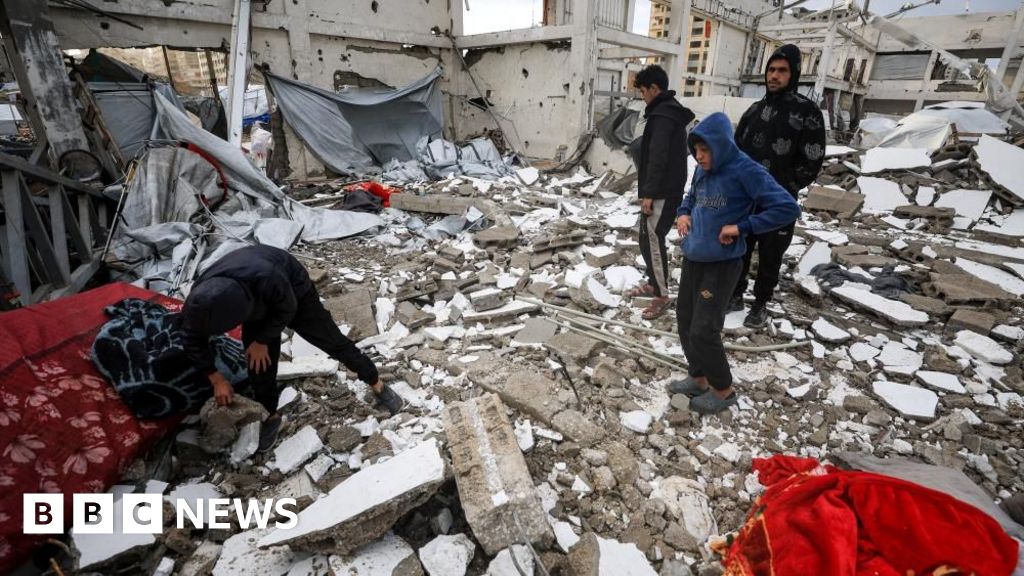
Israeli media cite official accepting Hamas figure of 70,000 war dead
Israel has previously cast doubt on figures from the Hamas-run health ministry, which the UN considers reliable.
 www.bbc.com
Israeli soldiers shot a Palestinian boy and stood around as he bled to death, video shows
If bibi doesn't have a great external enemy next door to wage war against: he goes to court and then jail.
A lot of these fascist seem to have the same problem.
A lot of these fascist seem to have the same problem.