I don't disagree with the article. I would offer this as a counterpoint:
I guess I'd say where I really disagree is this:
Because the "three timelines" thing was just because the fans couldn't just... accept that most games existed on their own.
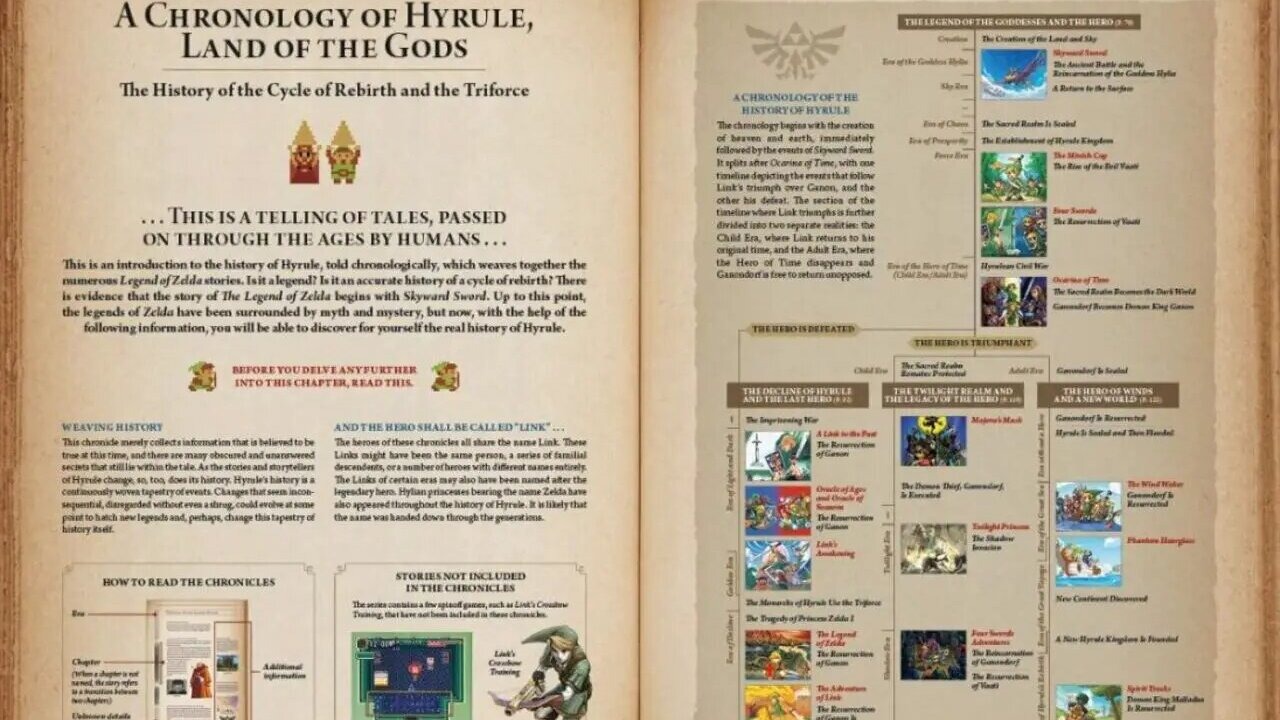
This just feels like a big stretch to me. Yes, Nintendo prioritizes gameplay over lore. Absolutely. But there are a lot of clear connections through them. It always feels like everyone wants to jump in on either insisting that the timeline is sacrosanct, or the timeline is something made up to appease fans who bugged them about it. It's why I really don't engage with the Zelda fandom despite it being my favorite video game series. The truth has always been in the middle. The timeline has always been there, but it isn't Nintendo's main focus and they're happy to fudge it around the edges.
Set aside the branching business for a moment and ignore the oddball games (the Capcom games, FSA, and TH). You can formulate three distinct timelines that are each pretty clear:
1) SS -> OoT -> ALttP/LA -> ALBW -> EoW -> TLoZ/TAoL
This is the classic timeline of the first five games, plus a few later entries. Aside from the Miyamoto interview referenced in the article that may or may not have been a translation error, I really don't think there's much controversy here. TLoZ/TAoL are obvious. ALttP was always supposed to be a prequel and was marketed as such, but was explicit within the game that this was not Ganon's origin. LA is pretty standalone, but was always assumed to be following ALttP. OoT was intended to be the backstory referenced in ALttP, but only did so in broad strokes. Again, Nintendo fudges it. SS is obviously the first. If there's any wiggle room, it's that ALBW and EoW are both clearly set as following ALttP, but don't clearly define themselves relative to the other or the first two games.
2) SS -> OoT -> TWW/PH -> ST
I don't think there even really can be any controversy here. They're all pretty explicitly set in this sequence.
3) SS -> OoT/MM -> TP
It's the smallest line, but I think the one that causes the most issues. Like I said before, TP really didn't explain itself at all. Officially, these games go in this order, and they fit without issue. But Ganondorf's past as shown in TP doesn't match up with what we saw in OoT. In hindsight, that's because this is the alternate timeline that followed after OoT Link went back in time and changed the past, but that wasn't at all clear at the time. And even for those who assumed these fit like this, it raised a lot of questions about how the classic games fit in either of these other two.
Like I already said, the 3D games started with a prequel to the 2D games, but it messed up some of the details and the other 3D games went off and did their own thing without much regard toward the 2D games. So yes, I think trying to fit the 2D games into a single timeline with the 3D games is an afterthought.
The place things get kinda ugly is trying to force in the games I excluded, primarily either developed by Capcom or derived from their games. OoS/OoA are their own thing and can just be crammed in wherever, as Hyrule Historia and the Zelda Encyclopedia show by moving them around. FS, FSA, and TMC form a neat little trilogy of games, but if it weren't for throwing Ganon into FSA, they would be completely independent of the other games. TH is just another multiplayer game, and really is standalone. So yeah, shoving these games into a master timeline is a bit forced. I don't think there was any master plan behind them, and they could easily be shuffled around again in the future.
That just leaves BotW/TotK. I already said that they're a soft reboot. There's a reason Nintendo shows them following the main timeline, but not connected to it. They're intended to be so far separated from the other games that the details of what happened in which timeline just don't matter. That's what makes it even sillier to try to insist that Rauru and Sonia founded the Hyrule seen in the classic games. You don't separate these games from the old ones by intertwining their origins. They're intended to be a clean break from getting dragged down in the lore details as mentioned in developer interviews without just throwing them away.
Anyway, sorry for the novella. Again, no one has to like or be satisfied with the timeline. But pretending it doesn't exist or was just all made up after the fact to shut up fans is just kinda ridiculous. Based on your last post, I don't think that's what you intended to argue, but it kinda reads that way. Might just be my issues with the Zelda fandom triggering me...



 www.zeldadungeon.net


 atari.com


