You are using an out of date browser. It may not display this or other websites correctly.
You should upgrade or use an alternative browser.
You should upgrade or use an alternative browser.
Who's trying to break the internet today?
- Thread starter NovaSaber
- Start date

What if I told you Google has already been doing this for years to show you search results that don't actually exist?

To be fair, most young people don't either. If we went around demanding that only people who are experts in every single field be eligible to serve office, we'd be living in anarchy.
Which, incidentally, is exactly what the tech bros want, and the reason they've spent the entire lifespan of the internet pushing the very talking point you just made. "You old geezers don't know how any of this stuff works, so leave us alone and let us govern ourselves." They got exactly what they want, and this is what they're doing with it.
Which, incidentally, is exactly what the tech bros want, and the reason they've spent the entire lifespan of the internet pushing the very talking point you just made. "You old geezers don't know how any of this stuff works, so leave us alone and let us govern ourselves." They got exactly what they want, and this is what they're doing with it.

Here's the thing, though. I don't think older people understand the internet at all. Their comprehension is still at the 'series of tubes' stage. Whereas younger people simply have a firmer grasp on the conceptual level.
More to the point, you don't need to be an expert, but you should listen to experts. And if we have learned anything from the fossils in Congress, it is that they don't care what the experts think. I would like to believe that a younger Congress would be more receptive to expert testimony that can speak to their experiences with technology. Especially compared to the elders whose big discovery was that they can enlarge the text on their phones so they can read a sentence a letter at a time.
More to the point, you don't need to be an expert, but you should listen to experts. And if we have learned anything from the fossils in Congress, it is that they don't care what the experts think. I would like to believe that a younger Congress would be more receptive to expert testimony that can speak to their experiences with technology. Especially compared to the elders whose big discovery was that they can enlarge the text on their phones so they can read a sentence a letter at a time.
Would these be the same "younger people" who don't even know what a file is, and are more likely to fall for a phishing scam than people three times their age? Or is your idea of the ideal age of a politician going to be permanently locked at "born between roughly 1975 and 1995"?Here's the thing, though. I don't think older people understand the internet at all. Their comprehension is still at the 'series of tubes' stage. Whereas younger people simply have a firmer grasp on the conceptual level.
I don't think "The thing you use to go on the internet is threatening to intercept what you go on the internet to look at and replace it with whatever Google wants you to see instead, without even telling you" is a difficult thing to explain, and would rightly be recognized as a danger to someone whose job is to keep abreast of dangers to the public and respond proactively. The problem is more that the vast majority of people currently serving public office in the US are no longer interested in doing that job, just generally. And no proposals of instituting age caps or even term limits is going to magically fix that, if the voters are content to keep voting for that sort of person.
Last edited:

Locked down computers, phones and tablets have absolutely tanked computer literacy, unfortunately.... Google, Apple and Microsoft don't want you to know how your computer actually works.Would these be the same "younger people" who don't even know what a file is, and are more likely to fall for a phishing scam than people three times their age? Or is your idea of the ideal age of a politician going to be permanently locked at "born between roughly 1975 and 1995"?

The patents office mandate isn't to sort out function or form, it's to make sure people own the rights to those functions and forms for legal purposes.

They outright lie about how it works. Microsoft still calls OneDrive a "backup" even though it actually moves your files into "the cloud" instead of copying them like that implies.Locked down computers, phones and tablets have absolutely tanked computer literacy, unfortunately.... Google, Apple and Microsoft don't want you to know how your computer actually works.
Is that what they're up to now? I'm still on Windows 10 so all the files in my OneDrive folder are still physically there and accessible when the internet's out. Unless it's files I created on another machine, in which case they don't get downloaded until I either try to open them or actively tell it to keep them on that machine.
See, that's the other thing. I'm a millennial with a computer science degree and even I'm not aware of all the dumb jive the tech companies are doing that oughtta be illegal. Who can keep up? I think tech needs to join agriculture, energy and transportation in having its own entire department dedicated to making regulations no legislator ever had to explicitly ask for.
See, that's the other thing. I'm a millennial with a computer science degree and even I'm not aware of all the dumb jive the tech companies are doing that oughtta be illegal. Who can keep up? I think tech needs to join agriculture, energy and transportation in having its own entire department dedicated to making regulations no legislator ever had to explicitly ask for.
I've never used OneDrive and I kinda moved to Linux before Microsoft started REALLY working to force it down everyone's throat. Windows is at this point just for a couple of games that use kernel level anti-cheat as far as my use-case goes.
I'm only clinging to Windows for the filesystem at this point. Hug Unix.
What's wrong with the Unix filesystem specifically? Granted these days unless I'm really trying to do something funky or do some major customization, I rarely leave my home directory. I just don't think about it much. The only part that is really a bit of a pain is mounting other storage volumes. KDE Plasma takes care of most of that for me, though.
When the mount points for external drives are inside directories located on the main hard drive, something has gone very wrong. Same with having a folder called "/etc". Oh, and despite having not changed at all since the '90s, I've seen cases where a program will change where it stores some of its important files from one version to the next, and I can only assume this is because the system is so confusing that they only just now figured out where they were supposed to go all along.
I like using multiple drives, and the CP/M/DOS model of each drive having its own root is just a better representation of where my stuff actually is.
Yea, the mount point system is somewhat convoluted, though I know what their line of thinking was. It was a solution to the fact that Unixoids tend to treat EVERYTHING as a file. Hard drive partitions containing filesystems themselves are files in /dev. A lot of early distros did not adhere to the FHS and there have been several revisions to it over the years, which has caused some files to move. It does have some advantages, though. I can create a partition on a separate HDD for /home, for example, which makes restoring things easier if the HDD the OS itself is installed on fails.When the mount points for external drives are inside directories located on the main hard drive, something has gone very wrong. Same with having a folder called "/etc". Oh, and despite having not changed at all since the '90s, I've seen cases where a program will change where it stores some of its important files from one version to the next, and I can only assume this is because the system is so confusing that they only just now figured out where they were supposed to go all along.

Speaking of the government breaking the internet, here's a nice breakdown of the consumer router ban that is going to destroy residential home internet in the US: https://mashable.com/article/us-router-ban-what-to-know
One thing that isn't being reported widely-enough:
So it's only a matter of time before we get approved firmware with Palantir backends for our existing hardware too.
One thing that isn't being reported widely-enough:
The FCC granted a limited waiver on Monday, allowing all previously authorized routers to continue receiving software and firmware updates — security patches, bug fixes, and compatibility updates — at least until March 1, 2027, at which point the agency says it will reassess.
The waiver exists because, without it, the Covered List rules would have immediately stripped those routers of update eligibility the moment they were added to the list, even for devices already sitting in people's homes. The irony here is that the FCC's ban is premised entirely on the security risks of foreign-made routers, which, by its own mechanics, will eventually cut off the security updates that keep those same routers from becoming liabilities.
So it's only a matter of time before we get approved firmware with Palantir backends for our existing hardware too.
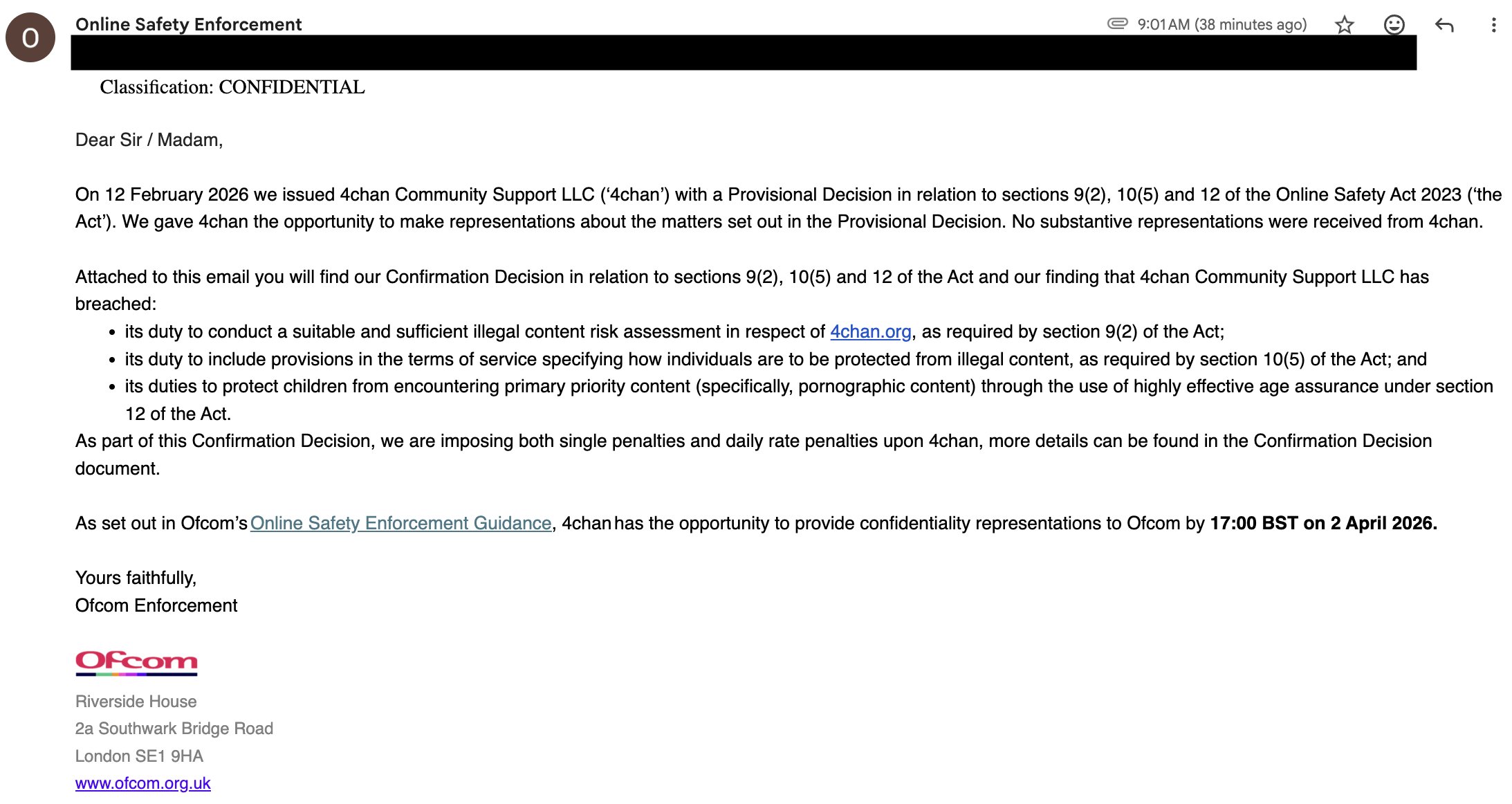
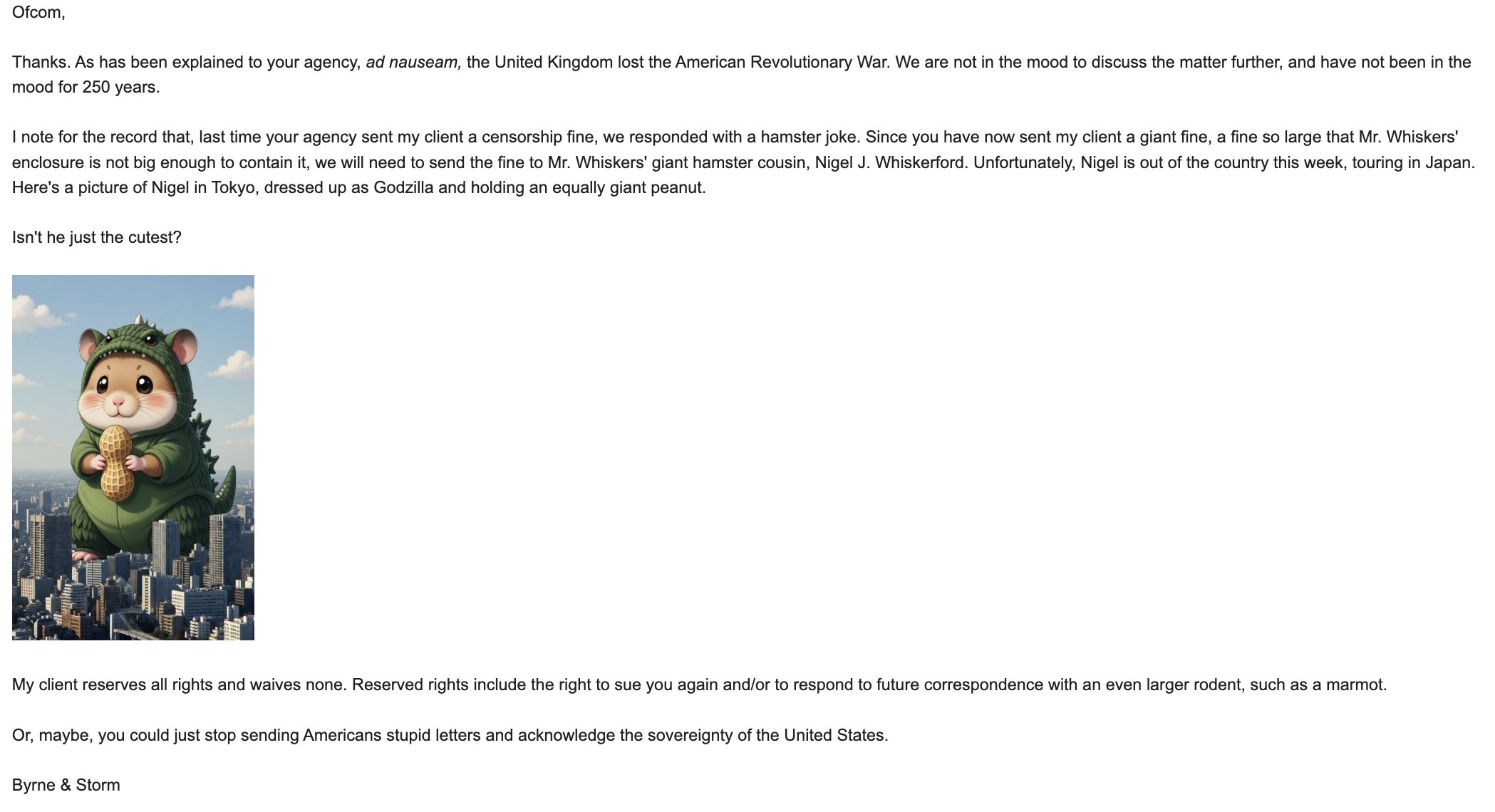
OFCOM is still attempting to fine 4chan. It is still going about as well as anyone other than the UK government could have predicted.