Skybound's The Phantom of the Opera

LordGigaIce

Another babka?
Citizen
So my joke mixing The Phantom of the Opera and Transformers maybe isn't so off! Skybound, who publishes the current run of Transformers comics, is doing a Phantom of the Opera four issue mini series as part of their Universal Monsters subline. Obviously this has nothing to do with the wider Energon Universe the Transformers comics are a part of, but even still... Transformers? Phantom of the Opera? Skybound seems to be trying to collect the Infinity Gems of my childhood obsessions. Of course I gave it a try, and half way in, I'm a fan. So I wanted to talk about it.

The creative team is Tyler Boss (writer) and Martin Simmonds (artist). The art style is very "painted," rather then a traditional comic style. This can make it hard to follow at times, but the narration and art direction is strong enough that it comes across more times then not. Admittedly I'd have preferred a more standard style, but the artistic take does fit both the time period and theme of the work.

To the story in question. The Phantom of the Opera was originally a novel from 1910 written by Gaston Leroux. Leroux, a court reporter and journalist more than a traditional author, managed to have his story capture public imagination by weaving a number of factual elements together with a mysterious narrative and love triangle. The real life crashing of part of the Paris Opera House's chandelier on the audience, the stories of ghosts in the Paris Opera House, the Opera House's real life underground catacombs and lake, and basing the lead heroine off of actual Swedish opera star Christina Nilsson, wrapped up with Leroux writing as he had as a court reporter, all gave the fictional work a sense of legitimacy. It was adapted as a movie in 1925, again in 1943, again in 1962, and 1989. Andrew Lloyd Webber adapted it as a musical in 1986, and it quickly caught on as a cultural phenomenon. The musical got its own film adaptation in 2004.

Despite the ALW version being the most well known... this is the Universal Monsters subline of comics. And the story itself is in public domain. So this was always going to be an adaptation of a Universal version to satisfy all the contractual concerns. Which means either the 1925 or 1943 version. And this is where this adaptation gets complicated. The 1925 version, a silent movie made famous via Lon Chaney Sr's horrific makeup as Erik, the Phantom, is very close to the book's plot.
The 1943 remake is... a much looser adaptation. Love triangle musical comedies had become very trendy by the 1940s, and Universal saw a Phantom remake as an ideal vehicle for this. It is a love triangle centred around music, after all.
This decision created a cascade of decisions that altered the story. First, Erik the Phantom is not a comedic character. He's tragic and can't be fit into a comedic archetype. So the character of Anatole Garron was created, a male opera star to serve as a more traditional love triangle foil for Raoul for Christine's affections. Raoul himself changes from a Viscount to a police inspector, and he loses his childhood history with Christine, again in the service of a more traditional mainstream comedic love triangle. Erik got to remain a tragic character... but there are additional issues. Three men vying for Christine's affections was too much... so he went from being a tragic would-be lover to being her estranged father looking to mentor her from afar. This brought its own issues though. How could Erik, a man born deformed who was essentially enslaved as a circus side-show act, father a child? So instead he became a normal man, a violinist, who is disfigured by an acid attack after he kills a publisher he thinks will steal his music. All of these decisions compound on each other to make the 1943 movie a very loose adaptation. And seeing as the ALW musical- again, the most well known version in the popular consciousness- also veers close to the book's plot and character dynamics, it leaves the 1943 movie as the odd one out.

I bring this all up because, well, the 1943 version is the version that Boss and Simmonds have chosen to adapt for this four issue mini. It's a shock, really, as the 1925 Lon Chaney Sr version is the one that Universal tends to default to when they want to represent the Phantom in their stable of Universal Monsters IP. At the same time, Boss has made some alterations in the plot. It's not a straight adaption of the 1943 movie. The best way I can describe it is that it's the 1943 movie with the pieces rearranged and plot changed to push it more in the direction of the book's plot. I'll get into specifics as I talk about each issue.

Anyway... with that preamble (some might say "overture") out of the way, on with the show. Lot 666 then...
 
Last edited:
LordGigaIce

Another babka?
Citizen
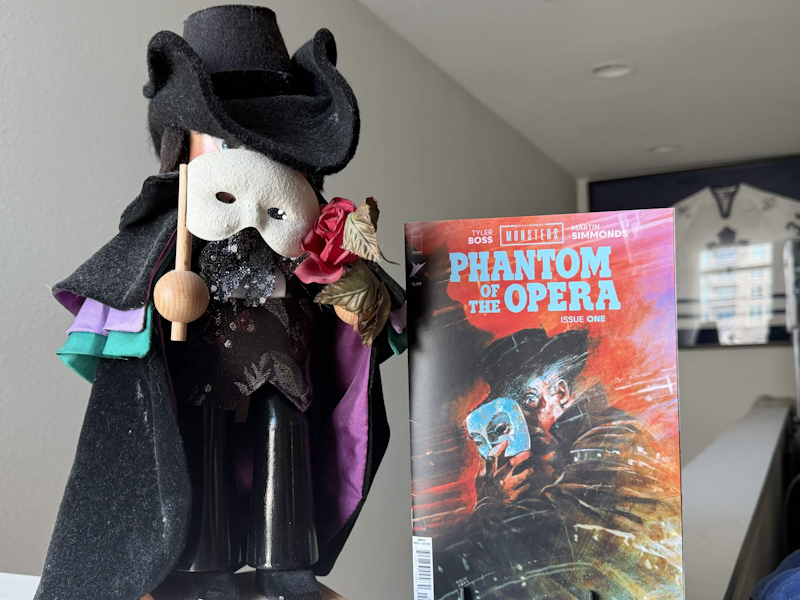
Issue 1 of 4

IMG2968.png


Issue one picks up right with Biancarolli's (the 1943 film's version of Carlotta) murder, hung in the middle of a performance of the opera Faust. Inspector Raoul Dubert (no longer the Viscount de Chagny) is trying to calm the crowd at the Opera, who have taken up spreading rumours previously only popular with the chorus girls, of the Opera Ghost. Raoul interviews a few people, including the manager of the Paris Opera, the lead conductor, star Anatole Garron, the Opera's rat catcher, and finally Christine Daaé, who has regained her classic surname (the 1943 movie had changed it to "DuBoise"). Christine admits she has motive, as Biancarolli's understudy. Raoul and Christine realize they know each other from childhood, both being from the town of Bergheim, in eastern France. Raoul says he remembers that Christine's father would play the violin in the town square as Christine sang. Raoul asks how her father is doing, and Christine mentions that he died as a result of "the War" (likely the Franco-Prussian War of 1871) and lost her mother from sickness.

It's here that the 1943 movie's changed to bring it more in line with the classic narrative. Once again, the '43 movie Christine's surname DuBoise is changed back to Daaé. Additionally, in the 1943 movie Raoul didn't know Christine from childhood. In the book- and ALW musical- they did. In the classical narrative Christine's father Gustave, a famous Swedish violinist, is hired to perform in the home of the Count de Changny. The Count's son Raoul and Gustave's daughter Christine hit it off and have a childhood romance, before Gustave's death from illness forces her away, until they reconnect at the start of the story proper. Here, '43 Raoul remains a police inspector and not a noble, but a bit of the classic dynamic of them knowing each other and bonding over Christine's father's violin playing is kept.

This is important, because after Raoul takes his leave, Christine meets with the conductor of the orchestra. In the 1943 movie, when Erik, the Phantom, is made Christine's estranged father, he was a violinist in the orchestra. And was fired when a chronic illness in his hand resulted in a loss of aptitude. Whether or not this adaptation keeps that backstory remains to be seen. The conductor tells Christine of a genius violinist who had "his prime robbed of him by illness," but Christine mentions her father died in "the War." Obviously any number of things could be in play here, but given that Raoul and Christine's '43 characterizations have been pushed into a direction more in line with the book and ALW musical, it's conceivable that Boss is playing with expectations of the '43 movie to swerve and do a more traditional plot. It remains to be seen.

Furthering this is Raoul finding a letter presumably from Biancarolli's murderer that was written on stationary from a musical publishing house, Pleyel and Sons. He goes to the office only to find it closed, and likewise under a murder investigation as Monsieur Pleyel has been murdered. Raoul believes this and the murder of Madame Biancarolli are related.
Of course we know that it is. This was not presented as a mystery in the 1943 movie. We the audience see Erik lose his job as a violinist, try to sell his masterpiece to Pleyel in a desperate gambit to survive, see him make a mistake believing Pleyel has stolen his work, kill him, and have Pleyel's assistant throw acid in his face, deforming him. Boss playing this out from Raoul's point of view, where he does not know these things, would make for anemic mystery. Boss himself, in a letter in the back of issue one, notes that he expects most readers of this mini to have some level of familiarity with The Phantom of the Opera. So I am thinking he's not going to adapt this 1:1 and we might see some of the '43 movie's plot changed to bring it more in line with the book and ALW musical, as we saw with Raoul and Christine's relationship.

We cut to Christine in her dressing room, being tutored by a voice behind her mirror, who we know is Erik, the Phantom. He coaches her to overcome some issues that have been holding her back now that she has a chance to be a leading lady of her own, and Christine is astounded by her own improvement. Erik calls himself her Angel of Music, a being that in both the book and ALW musical, Christine's father said he'd send to her once he was in heaven. This is another change to push the '43 setup more in a traditional dynamic because "Angel of Music" was never spoken or used in the 1943 movie. The issue ends with Erik behind Christine's mirror, talking about the things they will accomplish together.

Right now, as someone familiar with The Phantom of the Opera and most of its iterations, I'm guessing how faithful this adaptation will be to the 1943 movie whose characters and iconography it uses. Things have already been changed in the name of making things more in line with the traditional narrative. So I'm wondering... will Boss commit to the '43 movie's changes and have Erik be a once genius violinist, deformed thanks to a misunderstanding, who is secretly Christine's father? Or is Boss playing with that change, re-arranging the pieces to present Erik in his more traditional role as a born-deformed prodigy longing for Christine as a spurned lover? There's enough evidence in issue one to point to both, and part of the fun here is seeing how Boss goes with it.

On its own? It's a very gothic and moody adaptation, another change from the bright and colourful and sometimes cheerful 1943 version that brings it in line with the book and musical. What I like is that even if they end up sticking close to the '43 movie's plot... the change in tone and the artistic flair on display will be enough to give this take on it value.

I was very pleasantly surprised to see that The Phantom of the Opera was getting a miniseries, from Skybound of all companies. And issue one lived up to that hype.
 

LordGigaIce

Another babka?
Citizen
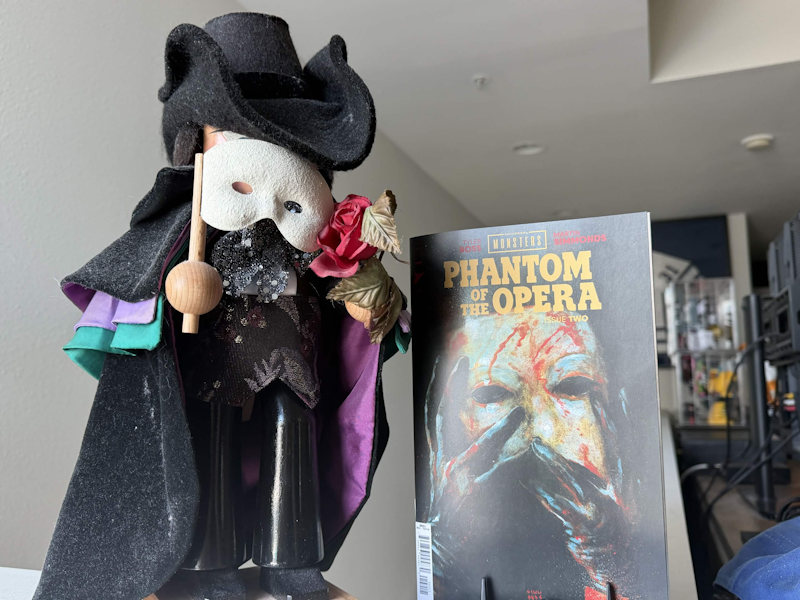
Issue 2 of 4

IMG2970.png


Issue two picks up with Christine leaving her vocal coach, as she's fully committed to learning via her "Angel of Music." Christine has, with Erik's help, become a sensation in Paris and Raoul saves her from being harassed by someone wanting her autograph. Christine asks Raoul if he'll be at her next performance, and Raoul jokes that he can't exactly afford regular opera tickets on a police inspector's salary (he's really not the Viscount de Chagny, patron of the Paris Opera House here) and Christine remarks that it's ok, he'll be able to attend at no cost as her guest. Raoul jokes that he doesn't even like opera, but Christine remarks that she's sure he likes her. The two make plans for the night, but Erik is lurking above, on the roof of the opera, observing everything.

Meg Giry tells Christine that the conductor is looking for her. Meg informs her that he's in the storage room "downstairs" checking on costumes and Christine heads down. She lights a lamp in the dark room, and sees it filled with fireflies, but then sees a glowing yellow skull. She shrieks and faints. We will later find out that this was her glancing Erik's unmasked face. Which is a hint that perhaps we're again moving in a more book/musical direction, and Erik's face is classically described as yellowed and skull-like, whereas the '43 movie's deformity was more non-descript. Erik takes her fainted body and brings it upstairs, leading her to be found by Anatole Garron who wakes her and gets her medical attention.

Anatole Garron was an original character made for the '43 movie, the male lead at the Paris Opera who serves as a traditional comedic foil for Christine's affections with Raoul. Again, we are moving in a more traditional direction. The romantic angle with Anatole is very faint. He calls Christine "little lamb" and seems fond of her, but he never seems overtly romantically tied to her. And when Erik expresses his distaste at Christine's romantic escapades later in the issue, it's entirely centred on Raoul, not Anatole.
We move back into '43 territory though, with Erik seemingly upset that Raoul is a distraction to Christine's ambitions as an opera star, rather than clearly being jealous of him like he is in the book and ALW musical. So if they want to stick to the '43 plot of Erik being her father rather than would-be lover, then this would fit. Again, we'll have to see.
Anyway Erik expresses this disapproval and Christine angrily tells him that if that's how he feels, he can go. Raoul overhears the argument, but Christine brushes it off as her just warming up her voice.

Christine delivers another knockout performance, but later confides she can't do this alone and begs for the Angel of Music to return. She faints after the performance, however, and medics rush to her. Meanwhile Meg Giry gets a note she thinks is from Anatole Garron, telling her to meet her on the roof. She goes up and confesses her love to Anatole, saying she poisoned Christine, wanting to usurp her burgeoning stardom so she and Anatole can be the co-stars of the Paris Opera. The figure on the roof isn't Anatole, however, it's Erik. Who, having deduced that Meg poisoned Christine, has led her onto the roof to toss her off, killing her. Ending issue two.

The introduction of Meg is another addition to the 1943 setup that pulls it closer to the traditional narrative. Meg wasn't in the 1943 movie. In the book, Meg is a chorus girl and ballet dancer who only casually knows Christine, and who more or less vanishes as a character once Christine ascends to stardom. In the ALW musical she gets a bit of a glow up, now Christine's closest friend and surrogate sister. Here, a more villainous Meg is kind of inline with the book portrayal. She was never malicious in the book, but kind of talks down on Christine before she hits it big. She seems jealous of Christine, both for her ascended stardom and her perceived relationship with Anatole, but as I said the Anatole/Christine romance is very much downplayed in this adaptation. So how Boss continues to weave these elements from the 1943 movie, the original book, and the famous ALW musical is one of the highlights for me.

If you're not as deeply into the Phantom as I am, it's still a very moody, brilliantly artistic adaptation of a classic story, so half way in? Still a huge recommend from me.
 
Last edited:

CoffeeHorse

Hanging in there
Staff member
Council of Elders
Citizen
I resent the 1943 one for the irreparable damage it did, but this sounds so utterly bonkers that I have to check it out. Taking that plot but making something moody out of it is crazy, but maybe crazy enough to work.
 

LordGigaIce

Another babka?
Citizen
I resent the 1943 one for the irreparable damage it did...
I do too. What's funny is that the 1943 Phantom played by Claude Rains is my mind's eye of what Erik should look like, at least in full costume. The cape, hat, mask... that's the look that sticks with me more than even the ALW musical look, which has sort of become the pop culture default. So I love the look of 1943 Erik... even if I think that version's narrative is utterly off and wrong and kind of ground zero for a lot of other issues with the property. It's kind of like how All Star Batman and Robin is a terrible book... but the art is nice.
And the 1943 stylings done in a moody, gothic painted style is certainly a mood.

...but this sounds so utterly bonkers that I have to check it out. Taking that plot but making something moody out of it is crazy, but maybe crazy enough to work.
It's a trip. It's trying to be one part 1943 movie, one part ALW musical, and one part book/1925 movie, and it's not really fumbling it? It's a really interesting adaptation. Not what I would have done or preferred, but if Tyler Boss can keep this energy up for two more issues then I'll consider it a success.
 
Last edited:

LordGigaIce

Another babka?
Citizen
So issue three came out, and I managed to read it in the car as I waited for the lady who was blocking my space in the parking lot to move. Before getting to that though... I wanna talk about Universal's Monster franchise and their Phantom identity crisis.
The Universal Monsters franchise technically starts in 1913 with the original Dr. Jekyll and Mr. Hyde. 1923's The Hunchback of Notre Dame and 1925's The Phantom of the Opera followed, but the franchise wouldn't really solidify and take off until 1931's twin hits, Dracula and Frankenstein. The Mummy, The Invisible Man, The Bride of Frankenstein, and The Wolf Man would all be released between 1932 and 1942. Sequels and crossovers were common even early on, and it really was the first of what we'd now call "a cinematic universe."
The last hurrah of the franchise came in 1954 with The Creature from the Black Lagoon, who had two sequels in 1955 and 1956. 1956's The Creature Walks Among Us is the last Universal Monsters movie released in the "classic" canon. That the Creature ended up being the last hit of the franchise kind of tells us why it all slowed down. While the Bride of Frankenstein was mostly a new character created for the films, she was rooted in the lore and a subplot of the classic Frankenstein story. Likewise Larry Talbot's Wolf Man was an original character, but his movies were steeped in werewolf lore from Europe dating back to ancient times. The Creature was an entirely new creation, and one who had a distinct sci-fi flare to him.
The classic horror stories rooted in Gothic literature and mythology that had been very popular up through WWII had become old hat, and the new horror that was dominating cinema in the 1950s was sci-fi based. The Creature was Universal's attempt to adapt to that.

Of course in time the classic Universal Monsters became retro and cool once they were no longer "old and outdated." As their heyday tended to coincide with the explosion of cinema as popular entertainment starting with the sound era, the emerging "Universal Monsters" tended to focus on the big ones from that era. Dracula. Frankenstein('s Monster), the Bride, Wolf Man, Invisible Man, and Mummy. The Creature at times for something a bit more out there. Dr. Jekyll/Mr. Hyde, the Hunchback, and the Phantom got included as well, but they occupied awkward spots in the "canon" because their first films were from the very early days of Universal Studios, before the "Monsters" franchise really solidified, and before sound in cinema.

As far as Phantom goes, this got compounded by the fact that there are two movies. Not an original and sequel, but an original and remake. The 1925 silent film staring Lon Chaney Sr and the 1942 remake staring Claude Rains. The 1925 film is far closer to the original novel by Gaston Leroux and Chaney's makeup as Erik the Phantom is properly iconic, but its pre-sound nature made it awkward as a fit with the more well known Universal Monster movies. The 1943 film, by contrast, is in sound, has lavish sets shot in beautiful technicolour, and is all around a gorgeous production. Which would make it a shoe-in as Universal's "representative" for the Phantom except... well, as I stated in earlier posts in this thread, it diverges quite a bit from the book's plot. And seeing as the very popular ALW musical that had codified what the Phantom story is in the popular consciousness leans heavily on the book... it makes the 1943 movie an awkward fit too.

Universal had dealt with this problem by splitting the difference. Back in the 90s, when I was a kid getting into classic cinema, Universal released a VHS collection of their Monsters franchise, and the version they included for Phantom was the 1943 version. At the same time, however, they worked with the USPS to issue a commemorative set of Universal Monster stamps and used Lon Chaney's image from the 1925 version to represent the Phantom in that set. They tend to default to the 1925 version when working with NECA for Universal Monsters figures, and have opted to use the 1925 version as the basis for the Phantom in their new theme park, Epic Universe. At the same time, however, they used clips of the 1943 version to represent the Phantom in the announcement trailer for their aborted Dark Universe project (which, as I hinted at above, was not the worst idea in concept, even if the execution was bungled).

I bring this all up because as we get to issue three of this four issue miniseries, the letters page (Monster Mail!) is finally printing people's reactions to this series specifically rather than just the Skybound Universal Monsters line in general. A few letters ask why they're using the 1943 version as the basis for this run, and Tyler Boss very openly states the 1943 film is the version that Universal asked them to use. This is very interesting because between the use of Lon Chaney's Erik in the NECA action figure space and the new theme park, it seemed like they'd finally settled on the 1925 version as the "definitive" version. Yet when it came time to do a brand new comic series, they requested the 1943 version be the basis. Seems like even in 2026... they've decided to split the difference.

Still, as noted above, Boss seems to have taken the general approach of using the 1943 movie's verison of characters and setup, but pushing it in a direction more reminiscent of the Gothic tones and backstory of the original novel and ALW musical. How that continues in part three? Welll....
 
Last edited:

LordGigaIce

Another babka?
Citizen
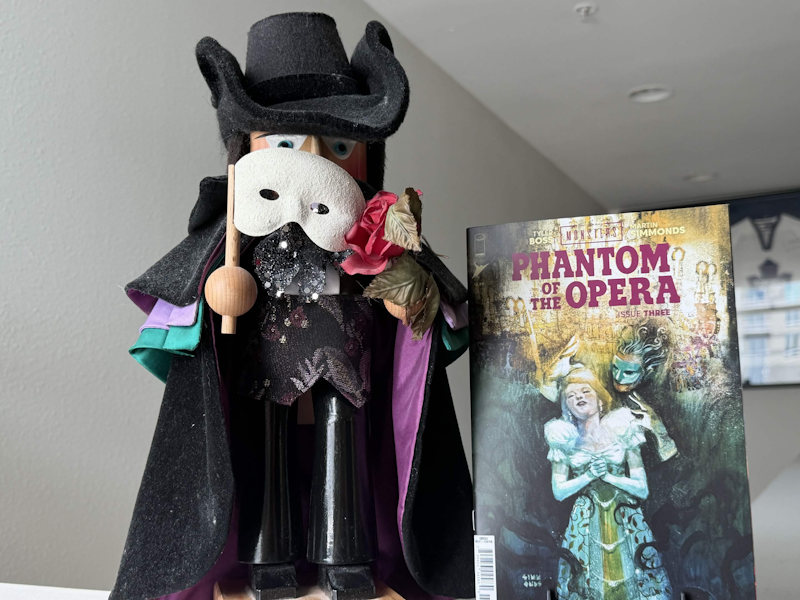
Issue 3 of 4

IMG3284.png


Poor Meg Giry, who's had a heel turn from Christine's best friend to would-be conspirator, is found dead on the streets outside the Paris Opera House. Inspector Raoul Dubert finds the note she was carrying telling her to meet her on the roof, supposedly from Anatole, and questions him about him possibly having affairs with both Meg and Biancarolli. Anatole denies it, but Raoul arrests him on suspicion of murder. Christine* protests and begs Raoul not to do this, but he leads Anatole out of the Opera in handcuffs.

*I touched on this before, but I forgot to expand on it. In the 1943 movie, Christine Daaé had her name changed to Christine DuBoise. This was in line with changing her from a Swedish peasant girl to being from provincial France, as "Daaé" is a Scandinavian surname, not a French one. Hence the change to "DuBoise." This series, in attempting to nudge the 1943 story closer to the original, changes it back to "Daaé," but keeps Christine's revised 1943 origins as being from provincial eastern France. Christine being Swedish rather then French is a detail a lot of people miss, and I think Boss may have just mistakenly assumed "Daaé" was a French name... it's not a huge deal, but I did find it kinda amusing. Anyway...

Christine is back in her dressing room and talking to the "Angel of Music" from behind her mirror. Martin Simmonds' art is brilliant, managing to make the Phantom and Christine talking to each other despite one being behind a trap door/mirror look absolutely poetic. The Phantom explains that Meg and Anatole conspired against her (well he's half right about that) and that with them gone no one will hold Christine back. He proclaims that Christine's career will make everything "perfect," and that he'll protect her and never let her go.

Meanwhile the lead conductor and manager of the Opera House are discussing the disaster that has befallen them each time they attempt to put on a production of Faust. The manager excuses himself, saying he's been up all night and needs a glass of wine and rest. The conductor is then visited by the Phantom, who promises him that if he agrees to do what he says, he'll help put an end to all the madness. The conductor agrees, and abruptly announces an end to the run of Faust. Two murders in two shows is a bad omen, and though he's clearly operating on the Phantom's orders, he sells it as not wanting to tempt fate a third time. Instead, he says they will be putting on an all new composition, an original opera called Don Juan Triumphant.

Ah.... Don Jaun Triumphant. Don Juan Triumphant first appeared in the original novel, as Erik the Phantom's "masterpiece." Christine could hear him playing it, and described the music as powerful, sad, and emotionally overwhelming. It's never properly performed though, and it's implied Erik doesn't actually finish the opera until the end of the book, after which he has the confrontation with Christine, Raoul, and the Persian and dies shortly thereafter. In the book, it's the musical Faust that is the main opera the Paris Opera House is putting on, and the show that Erik first abducts Christine from.
The ALW musical did away with Faust entirely (all of the IC operas in the ALW musical are fictional, probably for reasons related to rights issues) and instead, Erik forces the Opera's managers to put on his original opera, Don Juan Triumphant. The show in the world of the musical is much more "modern" then the fictional operas that reflect the eras they were supposed to be written in, indicating that Erik is a musical genius ahead of his time. And it's during Don Juan Triumphant that he abducts Christine.
Here, both Faust and Don Juan Triumphant are used. Faust is the opera that the Phantom sabatoges, to clear way for his own work, Don Juan Triumphant, to take centre stage. This is notable because the 1943 version of the Phantom, Erique Claudin, did write an original opera, but in that movie it was a soothing score titled Lullaby of the Bells. The change to the much more jarring and emotional Don Juan Triumphant is another case of Boss bringing the 1943 movie in line with the original book and the ALW musical.

Anyway of course the Phantom demands that Christine play the female lead in his opera, but Christine pipes up at the cast meeting that they need a male lead to play the title character Don Juan. Enter Anatole Garron, who claims that the police let him go due to lack of evidence. Christine is cold and mentions it's a "pitty" that they let him go, as she fully believes the Phantom about Anatole conspiring against her.
There's another addition to the Opera, a Maria Rosselini. Who seems to be a Vampire: The Masquerade reference? Anyway she's presented as an older retired prima donna who's been paid to come back to serve as Christine's understudy now that Meg has been murdered. Maria and Christine talk, and Maria asks Christine what compelled her to want to be an opera singer. Maria says for her, in her prime, it was the adoring crowds. What compels Christine?
Here, Christine mentions her father. Saying he was the most talented violinist that she ever heard, and that had he been given half a chance, he could have been one of the greats. That's what compels her. Maria mentions that it sounds like that was her father's drive, not her's. Maria asks for Christine's reasons, not her father's, and Christine doesn't have an answer.

Meanwhile Raoul finds the assistant to Monsieur Pleyel, the publisher who was murdered just before Biancarolli's murder. The assistant seems upset that Raoul found her, and Raoul mentions that she was the only one on Pleyel's staff who never picked up her last wages after his murder. The assistant confesses that she not only found her employer dead, but saw his murder. She found Monsieur Pleyel arguing with an "armature composer," who accused him of stealing his work. The two began to fight and the assistant came in just as Pleyel was strangled to death. She threw etching acid at the attacker, who ran off as his face was burning. It's because the acid burnt his face that the assistant laments that she'll be no use in providing a description to a sketch artist- the attacker, if he's even still alive, won't look anything like he was. Raoul asks what the work was that the attacker accused Pleyel of stealing. The assistant says it was Don Juan Triumphant.

Earlier I wondered if they'd keep the 1943 setup of Erique Claudin/the Phantom being a musician who was disfigured by acid and who was secretly Christine's estranged father, or if they'd swerve to something closer to the book. It seems very likely after all of that they're going with the "acid and Christine's father" setup after all. The brief flashback we see of Christine's father shows his face in shadows very reminiscent of the Phantom's mask, and the backstory of Erique being disfigured by acid after strangling the music publisher after a misunderstanding is right out of the 1943 movie. There we watched it happen as part of an ongoing story... so I admit it does fall flat as a reveal to a mystery since anyone who's seen that movie knows what happened. And the reveal is... what happened.
Still, knowing that Universal mandated that the 1943 movie be used for this comic series does shed some light. Perhaps a huge swerve to push even closer to the book couldn't happen. They wanted the 1943 version, and this is that. Just presented in a tone and style and with some minor changes that do push it closer to the book...

Meanwhile, the Paris Opera is preparing to hold its first production of Don Juan Triumphant. The Phantom tells Christine this is the big moment that will make Christine a star, and everyone will see what he "should have been." Christine catches this, and the Phantom corrects himself, to say "we." Christine shrugs it off and goes to leave her dressing room, but it's locked. She calls for someone to open the door, and we see that two police officers are standing guard. And Raoul and Anatole walk by, with Raoul telling them that Christine is not to be let out under any circumstances.

He and Anatole later confirm that Anatole's earlier "arrest" was a charade, part of a larger plan to lure the Phantom out. The Phantom will get his opera, but by putting an older former star in Maria in the lead role, it will tease him out. Raoul has police officers covering the Opera House, waiting. This is both a reference to the 1943 movie, and the ALW musical, both in which Raoul comes up with a plan to lure the Phantom out of hiding by messing with his demands for an upcoming performance.

The Phantom is enraged when he sees Maria take the stage instead of Christine, and Raoul catches sight of him in the rafters. Raoul chases after him, with the Phantom going higher and higher, and drawing a sword. Raoul pulls a gun and orders the Phantom to halt, but the Phantom doesn't attack Raoul with the sword. He attacks the chain holding the Opera House's chandelier. The chandelier crashes, killing dozens of people below. Raoul has no choice but to try and maintain order and has to let the Phantom go... who retreats to the secret passages around the Opera House and smashes Christine's mirror from the passageway behind it. Christine, still stuck in her dressing room, is entranced by the Phantom. She takes his hand they begin to descend to the cellars of the Opera House. This is a VERY ALW twist, as Christine being abducted during Don Juan Triumphant is right out of the ALW musical. And the Phantom causing the chandelier crash during Don Juan Triumphant is a plot point very specific to the 2004 movie version of the ALW musical.
 
Last edited:

LordGigaIce

Another babka?
Citizen
So it REALLY looks like they're going to stick with the 1943 plot of the Phantom as being Erique Claudin, a musician disfigured by acid and Christine's estranged father. This is a huge departure from the book and... never my favourite version.
Part of what makes Erik the Phantom so compelling is that he's unquestionably a bad man, a monster. A murder. Still, these actions are fueled by hatred and bitterness that stem from being born disfigured and being denied even a mother's love for his entire life. Book Erik's final monologue is all about how he's sick of having to live in the shadows, having to rely on traps, blackmail, and fear, and how if he had the love of someone else, he could just be a normal man. He talks about how his greatest ambition is to just have a wife he loves and can go on walks with on Sundays. Musical Erik, who shares Book Erik's "deformed from birth" backstory, likewise lashes out at the world for never showing him an ounce of compassion and that he was "condemned" before he even committed a single crime due to his face. In both cases Christine's kiss at the end is what convinces him to let her and Raoul go, that getting just a little bit of genuine love and compassion makes him realize what a monster he's been, and gives him the clarity to do the right thing.

The 1943 movie- and all other versions that copy its "normal man disfigured by an attack later in life" revision- robs Erik (or "Erique" as the 1943 version had it) of this very important factor in his obsession and bitterness. And by making him Christine's father well... it removes the fact that he's looking for love. He loves Christine and in his warped mind thinks that he if he can just get her to love him back, he can find happiness. Making it the story of an estranged father using his daughter, who doesn't know he's her father, as a tool to get his masterpiece the respect he thinks it deserves just isn't as tragic.

There's also the fact that Christine's father being dead is vital to her classic characterization. In both the book and ALW musical, Christine's mother died in childbirth. Her violinist father who nurtured her love of music was the only family she had. When he dies, it sends Christine into a bout of alienation and depression which is what primes her to be swayed by Erik pretending to be "the Angel of Music."
Here, in this new take on the 1943 setup, Christine thinks her father is dead, but it's also implied it's been years since he's been dead. Christine in the books and musical is a young woman (late teens to early twenties) trying to cope with the recent loss of her only family member and was vulnerable because of that. Not to say the loss of a father is something you can ever truly get over, but it seems with the setup Boss has provided, Christine has had too much time to come to terms with his loss to fall sway to the "Angel of Music" scheme. And of course in the book and musical, Erik is merely playing on her memories of her father, he's not actually her father. The 1943 version- and this comic it would seem- make him literally her father. It's still got room for an obsessive sort of love... but it's not hitting quite as hard as the classic version of events.

THAT BEING SAID... Tyler Boss promised a twist in the final issue. I have to think it has to be some kind of departure from the 1943 setup, because, well, everyone knows that. So everything I said here could be rendered irrelevant.

Either way, even if it does stick close to the 1943 setup, I'm still enjoying it all. The 1943 plot isn't my preferred take on Phantom, but Boss and Simmonds do a lot of very good work here to drag that very bright and bombastic movie into the realm of Gothic horror and romance of the original novel and ALW musical. Little touches that are absent from the 1943 version but are central to the book and musical, as well as the Gothic art style and darker tones, all do a lot to make this worth a read, regardless of how it ends.

Anyway, there's one more issue to go. One might say we're passed the point of no return.
 
Last edited:

CoffeeHorse

Hanging in there
Staff member
Council of Elders
Citizen
1943's stupid backstory was a mistake I resent for the decades of damage it did... but removing it here also would have been a mistake. I don't want any future from-scratch adaptation to go with that approach ever again (and thanks to ALW they probably won't), but this is a weird what-if moody adaptation of 1943. It has to actually be 1943 at its core or there's no point.

It's like if Universal asks them to do Dracula 1931 next, and they proceed to follow that plot but throw in little nods to the book where they can... including drawing a book accurate Dracula. It wouldn't work. There is no point bothering with the 1931 version of the story at all if you remove the only reason we remember it.
 

LordGigaIce

Another babka?
Citizen
I don't want any future from-scratch adaptation to go with that approach ever again...
We probably won't see future adaptations going with the 1943 backstory but we are going to get a "set in modern day and inspired by Twilight" take. So strap on in!

...but this is a weird what-if moody adaptation of 1943. It has to actually be 1943 at its core or there's no point.
That's fair. I think what's throwing me is that they have leaned into the book within the 1943 framework. The backstory of Christine and her father as a travelling father-daughter violinist/singer act through the countryside, Christine having a childhood relationship with Raoul, her even having the name "Daaé" again... not to mention the Angel of Music subplot which the 1943 movie omitted entirely, replacing the '43 movie's Lullaby of the Bells with Don Juan Triumphant, and the general overall more moody and Gothic tone which is more book then it is '43 movie. It's created this kind of guessing game where you go "ok this is the '43 movie at a base level but if these things were changed... what else is changed?"
Like having the chandelier crash and Christine's abduction during a performance of Don Juan Triumphant is tickling me because that's so specific to the 2004 movie that I kinda love it. That's a very unique mix of those elements.

And then you have Tyler Boss going "there's a twist coming."
And I have to think anyone spending money on a comic adaptation of The Phantom of the Opera knows the story of the '43 movie and the "he was Christine's dad" thing... so all of this is really fuelling my inner nerd to try and guess where exactly they're going with it all.

None of this is bad, honestly. The vibe of "it's the 1943 movie but it's skewing closer to the book with some ALW sprinkled in" is a fun twist in and of itself, the hiccup of returning Christine's Scandinavian surname from the book but keeping her 1943 French backstory notwithstanding.
The speculation is a very cool thing. It runs the risk of being potentially disappointing, but I'm enjoying it all so much that even if they just go straight 1943 with it, I'll consider it a success. The writing and art's commitment to Gothic moodiness and the reinterpretations of that movie's plot points are all super strong.

There's also the funny thing of how Universal doesn't seem to know which of their Phantom movies will be their "representation" for Erik in their Universal Monsters pantheon, but honestly I'm just happy he's in the discussion again. He can get left out entirely, sadly.
 

CoffeeHorse

Hanging in there
Staff member
Council of Elders
Citizen
We probably won't see future adaptations going with the 1943 backstory but we are going to get a "set in modern day and inspired by Twilight" take. So strap on in!

I want to die.

**stuff**
I can't believe they made me wish they leaned into 1943 even harder, despite my distaste for it. I wish they kept Lullaby of the Bells. I wish they kept the name changes. I like the 1943 name changes. The less it pretends to be Leroux's story the more I'm okay with it. It can be its own weird thing.

Like having the chandelier crash and Christine's abduction during a performance of Don Juan Triumphant is tickling me because that's so specific to the 2004 movie that I kinda love it. That's a very unique mix of those elements.
Considering 2004 had some visuals inspired by 1943, it's fun to see that go full circle.

And it's nice to see 2004 get any acknowledgement at all that isn't just "He doesn't sound like Michael Crawford!!1!!one!" I can critique that movie all day but it deserves respect.

There's also the funny thing of how Universal doesn't seem to know which of their Phantom movies will be their "representation" for Erik in their Universal Monsters pantheon, but honestly I'm just happy he's in the discussion again. He can get left out entirely, sadly.

I suspect Universal decided to settle on 1943 simply because they still own it. They lost their rights to 1925 ages ago but people who didn't look into it too deeply might not know that. But at this point it would be public domain regardless. It's over.

Also, even if that weren't the case, if they want some iconography that's distinctly theirs, we have to admit 1943 gives them more to work with. Lon Chaney forever set the standard for Erik's face. But as far as his masked appearance (which should be the only appearance pushed by marketing!), 1943 set that standard. Despite everything else, that mask is more iconic than 1925's mask. It matters. In a lineup of monsters, the mask is how you know you're looking at Erik and not some impeccably dressed zombie.

Also Erik's lair. I miss all the death traps (thank you 2004 for trying) but visually 1943 set the standard like Universal set the standard for Frankenstein's lab.
 

LordGigaIce

Another babka?
Citizen
I want to die.
"Oh it's been twenty-two years we need a new adaptation!"
monkey's paw curls

I'll watch it... but I won't be happy about it.

I can't believe they made me wish they leaned into 1943 even harder, despite my distaste for it. I wish they kept Lullaby of the Bells. I wish they kept the name changes. I like the 1943 name changes. The less it pretends to be Leroux's story the more I'm okay with it. It can be its own weird thing.
I know it's minor but it really does amuse me that Christine has the name "Daaé" again but keeps her 1943 French backstory. Like... "Daaé" is a Scandinavian surname because book Christine was Swedish. As I said, minor stuff... but it's just funny to me is all because you know when someone in 1943 decided she'd be French they had the wherewithal to change the name to match.

I'm finding myself a bit fascinated by the changes made to the '43 story. On one hand... I don't like them because '43 is so different, you can't really make it work in the book's world.

Take Raoul and Christine for example. In the book they're childhood sweethearts and Raoul being from an aristocratic family factors into it because they employ Christine's father and that's how she and Raoul get to know each other.
'43 dispensed with that entirely and just made Raoul
a police officer who's dating her with no childhood backstory. The comic splits the difference by keeping Raoul a police officer but now saying they casually knew each other by coming from the same town.
Which does nod to the book... but it's also not as strong a connection as Raoul and Christine spending summers together and going on adventures based on her dad's Scandinavian fairy tales, you know? It's trying to force '43 into that, but you can't really get all the way, so why bother?

On the other hand... I'm fascinated by adaptation, and how stories change. I think the idea of "what if the 1943 movie were still the 1943 movie but also closer to the book?" has a lot of intriguing promise to it, and I think Boss as a writer and Simmonds as an artist have enough of the sauce, as the kids say, to pull it off. Boss clearly loves Phantom, and there's a lot of love worked into this.

Considering 2004 had some visuals inspired by 1943, it's fun to see that go full circle.

And it's nice to see 2004 get any acknowledgement at all that isn't just "He doesn't sound like Michael Crawford!!1!!one!" I can critique that movie all day but it deserves respect.
My dirty secret as a Phantom of the Opera fan is that the 2004 movie is my favourite film version. No, Gerard Butler doesn't sound like Michael Crawford, but he still fits the character (I could make the argument he's a better "sound" for Erik then Crawford) and he pours himself into it. You really feel Erik's loneliness, bitterness, and trauma in his performance. Him dejectedly singing "masquerade" at the end after he lets Christine and Raoul go always gets to me.

Also Erik's lair. I miss all the death traps (thank you 2004 for trying) but visually 1943 set the standard like Universal set the standard for Frankenstein's lab.
That's another reason I love that movie. It's based on the ALW musical which, as a stage production, couldn't really make the death traps work (I think there's a behind the scenes interview where he said he wanted to do them all but the mechanics of it on stage would have been near impossible for the time). Still, the movie went "hey we're not bound by the limitations of the stage, let's see what we can do."
Stuff like Caesar the horse, the hexagon torture chamber Raoul falls into, and the death trap on the way to the lair are all things that didn't have to be in a faithful adaptation of the musical, but they put them in anyway and I love it for that.
It's very refreshing when you consider something like Cats, which has the freedom of a movie but still weirdly limits its sets and blocking like it's a stage show. Phantom 2004 realized it was a movie first and foremost and took advantage.

I am looking forward to how Simmonds depicts Erik's lair and the catacombs and lake under the Opera in issue four though. We haven't seen it yet, and I adore the set design in the '43 movie. '25 (and '04 as a matter of fact) are both more accurate to what the underground lake really looks like, but '43 has a sort of otherworldly mystical quality to it that I love. So seeing that done up in Simmonds' excellent artwork should be a treat.

Also, even if that weren't the case, if they want some iconography that's distinctly theirs, we have to admit 1943 gives them more to work with. Lon Chaney forever set the standard for Erik's face. But as far as his masked appearance (which should be the only appearance pushed by marketing!), 1943 set that standard. Despite everything else, that mask is more iconic than 1925's mask. It matters. In a lineup of monsters, the mask is how you know you're looking at Erik and not some impeccably dressed zombie.
Boss actually mentioned that, that '43's mask is very iconic and he was happy to have that bit of marketing to work in his favour. '25's mask is so bad that there's a reason that most depictions of Chaney's Erik use the unmasked face. That '25 mask was... a choice. Not a good one, but a choice none the less.

For all my issues with the 1943 movie, Claude Rains in full Phantom getup is burned into my brain as what Erik, in full garb, should look like. I recently re-read the original novel, and that's what popped into my head. Ironically he had Lon Chaney's face under there 😛 But still, for all of '43's narrative fumbles, it nailed the art direction.
 

CoffeeHorse

Hanging in there
Staff member
Council of Elders
Citizen
I'll watch it... but I won't be happy about it.

I probably won't bother. It can't possibly work. For one thing... to be continued. VV

I know it's minor but it really does amuse me that Christine has the name "Daaé" again but keeps her 1943 French backstory.

As long as it sounds foreign.

It's an old class thing. Book Raoul is supposed to be out of Christine's league, to a degree that adaptations never acknowledge enough. I guess by 1943 stage performers had risen enough in status that the filmmakers thought that didn't work anymore, so they tried to flip it. I don't think it works, but Skybound's change doesn't hurt.

I think this story just doesn't work outside late 19th century France. In the unlikely event that we ever get a definitive film adaptation (or prestige TV miniseries) it needs to be a period piece, and lean into it hard. Nobody knows what to do with Raoul without that backdrop. We need to see his world, then we need to see Madama Valerius' apartment looking more humble than Erik's lair. We have lost so much.

My dirty secret as a Phantom of the Opera fan is that the 2004 movie is my favourite film version. No, Gerard Butler doesn't sound like Michael Crawford, but he still fits the character (I could make the argument he's a better "sound" for Erik then Crawford) and he pours himself into it. You really feel Erik's loneliness, bitterness, and trauma in his performance. Him dejectedly singing "masquerade" at the end after he lets Christine and Raoul go always gets to me.

Like I said, I can critique it all day long. I dislike the framing story (which is the stage show's fault, but still). The makeup department failed. Filming Masquerade in monochrome was a bold artistic choice... But it needs credit for the things it did right. Butler does a good job of looking and sounding like he enjoys killing. Anyone who's still trying to sound pretty during the Final Lair has literally lost the plot. The snarling is appropriate. And he does a spectacular cape twirl. We needed an actor to finally remember that this is a sympathetic villain role, not an antihero role. There is a difference.

And adding the death traps, yes. Adding Caesar, yes. The visual nods to 1943, yes. It's a film adaptation of The Phantom of the Opera, based on the play. Not just an adaptation of the play. It's comprehensive.

For all my issues with the 1943 movie, Claude Rains in full Phantom getup is burned into my brain as what Erik, in full garb, should look like. I recently re-read the original novel, and that's what popped into my head. Ironically he had Lon Chaney's face under there 😛 But still, for all of '43's narrative fumbles, it nailed the art direction.

It's because 1925 didn't have much art direction, or much direction of any kind aside from Lon Chaney directing himself every time the director wasn't around to tell him no. No one else put any imagination into it. It was just a tediously shot page by page film of the book. At this point that tedious accuracy is the appeal, and if I'm granted three wishes I'm absolutely blowing one to have someone miraculously find a copy of the LA preview cut, but obviously audiences weren't impressed. They might have been right. We'll never know.
 

LordGigaIce

Another babka?
Citizen
I think this story just doesn't work outside late 19th century France. In the unlikely event that we ever get a definitive film adaptation (or prestige TV miniseries) it needs to be a period piece, and lean into it hard. Nobody knows what to do with Raoul without that backdrop. We need to see his world, then we need to see Madama Valerius' apartment looking more humble than Erik's lair. We have lost so much.
I fully agree. I think the time period of late 19th century France is vital to the story. It's baked into it.

It's an old class thing. Book Raoul is supposed to be out of Christine's league, to a degree that adaptations never acknowledge enough.
That's my main issue with the framing device of the ALW musical and 2004 film. It paints a picture of a future where Christine married Raoul and became a Countess. Which the book says is impossible. It also takes something from Raoul as a character because in the end his hero moment isn't beating the villain, it's abandoning his title, wealth, and career in the Navy to be with Christine. He even leaves his country behind, as Leroux strongly hints that they go to Christine's native Sweden to live a quiet life in some secluded village.
The ALW framing device of Christine marrying Raoul and becoming a Countess is fine I guess but it robs Raoul of that sacrifice and ultimate gesture of true love.

Like I said, I can critique it all day long. I dislike the framing story (which is the stage show's fault, but still). The makeup department failed. Filming Masquerade in monochrome was a bold artistic choice... But it needs credit for the things it did right. Butler does a good job of looking and sounding like he enjoys killing. Anyone who's still trying to sound pretty during the Final Lair has literally lost the plot. The snarling is appropriate. And he does a spectacular cape twirl. We needed an actor to finally remember that this is a sympathetic villain role, not an antihero role. There is a difference.
I don't like the framing device but it's baked into the show so it's like... whatever. It's part of the package deal.
I get what they were going for with Erik's deformity. And it looks properly gnarly in some angles and under certain lighting, but yeah. They needed to kick it up a notch or two.
As for Masquerade... I get the feeling they thought "well if everyone else is in black and white then Erik's Red Death costume will pop more!" But yeah, I would have enjoyed more colourful costumes like the 1925 movie or the stage show. At least we have Batman, though.

As far as Butler goes... Erik is supposed to be a musical genius, but he's one with no formal training. Hell, he never even went to Persia in this version. He's lived most of his life in the shadows of the Opera and he's been self taught. So he should have a powerful and emotional but raw voice, which Butler captures. Crawford, as beautiful as his voice was, was too pretty and perfect a singer to be a guy who had to teach himself how to sing.
And absolutely... Butler had a tremendous cape twirl. Which is a necessity when you have a bad guy with a cape. He also does a good job alternating between being terrifying and pitiful, which is pretty much exactly what you need out of someone playing Erik.

It's far from perfect, but I do appreciate the 2004 movie a whole lot and I'm kind of happy to see it being re-evaluated now after it was pretty universally panned when it was released.

I don't know if we'll ever get a book accurate adaptation at this point, but if we did I think it would have to be a miniseries on prestige tv. The book's narrative is awkwardly structured and I think you'd need maybe 6-8 episodes to really get it all in.

And honestly? I'd love for a miniseries approach to try and preserve the mystery of the original novel, which isn't even a mystery anymore since everyone knows the story by now. The novel suffered the same fate as Dr. Jekyll and Mr. Hyde.
 

CoffeeHorse

Hanging in there
Staff member
Council of Elders
Citizen
I fully agree. I think the time period of late 19th century France is vital to the story. It's baked into it.

I think what we need even more than a better translation of the novel is a super annotated edition. There is so much important stuff that's glossed over in a sentence or two. Filmmakers read it and go "Wut?" and just cut the confusing bits instead of figuring it out.

That's my main issue with the framing device of the ALW musical and 2004 film. It paints a picture of a future where Christine married Raoul and became a Countess. Which the book says is impossible. It also takes something from Raoul as a character because in the end his hero moment isn't beating the villain, it's abandoning his title, wealth, and career in the Navy to be with Christine. He even leaves his country behind, as Leroux strongly hints that they go to Christine's native Sweden to live a quiet life in some secluded village.
The ALW framing device of Christine marrying Raoul and becoming a Countess is fine I guess but it robs Raoul of that sacrifice and ultimate gesture of true love.

And then they wonder why audiences don't care for Raoul. They've gutted his whole character. He's just a rich guy now, without everything that meant in that time and place. Adaptations have lost his sacrifice, and his whole fish out of water journey. He's an enlightened aristocrat interacting with superstitious simpleton peasants, slowly learning that there is actually something bizarre going on. And yes, ultimately leaving his whole world behind to go be a peasant in Sweden. But adaptations don't know what to do with that because we never get a good look at the world he's giving up in the first place.

I'm saying we need to see his dinner with Philippe.

But my other problem with the framing story is Raoul and Christine need to just be gone. It doesn't totally matter whether they're in some obscure village in Sweden or rural France as long as nobody knows. Raoul can't be seen again in Paris of all places.

I get what they were going for with Erik's deformity. And it looks properly gnarly in some angles and under certain lighting, but yeah. They needed to kick it up a notch or two.

Just CGIing off his nose would fix the whole look. Nothing else would need to change. There are shots where shadows land in just the right places and make it almost work as is. One extra shadow where his nose should be would sell it. The rest already looks vaguely skull-like in some shots.

To the film's credit, for as lame as the deformity is it's amazing that there are shots where it almost works. That's Schumacher for you. I have no doubt he planned on having lighting do most of the work. That was his happy place as a filmmaker.

As for Masquerade... I get the feeling they thought "well if everyone else is in black and white then Erik's Red Death costume will pop more!" But yeah, I would have enjoyed more colourful costumes like the 1925 movie or the stage show. At least we have Batman, though.

I hope whoever showed up with a Batman costume got a raise.

I'm sure that's going for, but I think they missed the point, and it's partly the play's fault for missing the point as well. It's another ripple effect of losing the class backdrop of the novel. The masquerade ball is a vulgar peasant party, just in an extremely opulent setting. We shouldn't be seeing all our core characters in expensive but monochrome outfits, contrasted with Erik's vivid red costume. We should see a bunch of peasants in cheap but still colorful outfits, contrasted with Erik rocking an absolute showstopper of a costume. He should look like the richest man there.

As far as Butler goes... Erik is supposed to be a musical genius, but he's one with no formal training. Hell, he never even went to Persia in this version. He's lived most of his life in the shadows of the Opera and he's been self taught. So he should have a powerful and emotional but raw voice, which Butler captures. Crawford, as beautiful as his voice was, was too pretty and perfect a singer to be a guy who had to teach himself how to sing.
And absolutely... Butler had a tremendous cape twirl. Which is a necessity when you have a bad guy with a cape. He also does a good job alternating between being terrifying and pitiful, which is pretty much exactly what you need out of someone playing Erik.

It's far from perfect, but I do appreciate the 2004 movie a whole lot and I'm kind of happy to see it being re-evaluated now after it was pretty universally panned when it was released.

I'm a lifelong Mussorgsky fan, so 'emotional but raw' kinda sums up my taste in music. If a shouty Boris Godunov is valid, a snarling Erik can be valid too. This isn't an album of thematically connected songs that just need to sound pretty. There is a drama here that needs to be acted.

I will say in Crawford's defense that his approach probably worked better live. I've had the pleasure of seeing Phantom live, and it was a solid performance, but I could tell there were bits that wouldn't work in any other format. I am glad the 2004 filmmakers understood they were making a movie, because it's just a different thing. I wish critics understood that, but they never have in hundreds of years. Opera critics are the worst of all time, and musical critics aren't far behind.

I don't know if we'll ever get a book accurate adaptation at this point, but if we did I think it would have to be a miniseries on prestige tv. The book's narrative is awkwardly structured and I think you'd need maybe 6-8 episodes to really get it all in.

And honestly? I'd love for a miniseries approach to try and preserve the mystery of the original novel, which isn't even a mystery anymore since everyone knows the story by now. The novel suffered the same fate as Dr. Jekyll and Mr. Hyde.

It will never be done, but prestige TV is probably the only way to do it. The 1925 LA preview cut was about as accurate as a movie is ever going to get, and my understanding is it was about four hours. And it still compressed some things, like combining the masquerade ball and the rooftop scene into a single night. The book is that dense.

On the mystery note, it is my understanding that the LA preview cut totally framed the Persian as Christine's mysterious suitor. That's partly why audiences freaked out so bad at Erik's face reveal. They were tricked into thinking this was a lame whodunit ghost story, and they were very bored because they thought it was way too obvious way too early. Then the mask came off and suddenly it was a completely different story. It hit harder because they thought they knew what they were going to see. That was a twist they can never pull off again.
 

LordGigaIce

Another babka?
Citizen
I think what we need even more than a better translation of the novel...
I just ordered a copy of the David Coward translation. I've been told it's a smoother read.

...is a super annotated edition. There is so much important stuff that's glossed over in a sentence or two. Filmmakers read it and go "Wut?" and just cut the confusing bits instead of figuring it out.
That's why I think a 6-8 episodes prestige series is the way to go. You could dedicate an episode or two to Erik and his adventures in Persia, easily an episode on Raoul and Christine's childhood friendship.

And then they wonder why audiences don't care for Raoul.
I love book Raoul 😭 He's a very rare thing. A deconstruction of the aristocratic male hero character who retains all of the archetype's best qualities. He's loyal, kind, sincere, and heroic. He wants what's best for Christine, to the point that he's willing to help her get away from Erik and then leave her alone if she doesn't want to be with him.
His deconstruction doesn't come from the surface level idea of making him a jerk, it comes from making him ineffectual as a hero despite his best intentions. He fails to beat Erik at every turn, and has to be bailed out by the Persian or Christine. His big heroic moment is giving it all up to be with Christine as a peasant somewhere in secret. Given that most deconstructions of his archetype default to just making the hero a jerk, I find Raoul quite refreshing.

He's also aggressively 21.
"What if they make fun of me for wearing a mask and costume to the mask and costume ball?"
Mood, buddy. Mood.

And then LND happened and if any good ever came from that, it's proving that unchecked Raoul slander can have disastrous consequences.... ANDREW.

I'm saying we need to see his dinner with Philippe.
I was introduced to Phantom through the ALW, and then the 1943 and 1925 movies. I read the book in middle school and was like "wait Philippe is kind of great why does everyone leave him out?"

Him being so angry at Faust he's munching on his own moustache is great.

But my other problem with the framing story is Raoul and Christine need to just be gone. It doesn't totally matter whether they're in some obscure village in Sweden or rural France as long as nobody knows. Raoul can't be seen again in Paris of all places.

Yep. The book framing device of Raoul and Christine just vanishing after her abduction and never being seen again the central mystery. How did this happen? How did a famous singer and one of France's most eligible bachelors (and an aristocrat at that) just vanish without a trace? That mystery is much more engaging than Raoul just being around, and being old and nostalgic (as much as that's relatable to those of us on a Transformers message board).

That's Schumacher for you. I have no doubt he planned on having lighting do most of the work. That was his happy place as a filmmaker.
I won't defend Batman and Robin, but I also think that movie did undue damage to his reputation. The guy has always had the sauce as a filmmaker and something with the mood and pageantry of Phantom is right up his alley.

I am glad the 2004 filmmakers understood they were making a movie, because it's just a different thing. I wish critics understood that, but they never have in hundreds of years. Opera critics are the worst of all time, and musical critics aren't far behind.
I feel like we've lost that recently as theatre kids have sort of taken over. I mentioned Cats, a much more recent ALW musical adaptation. The horror of it aside, the blocking and presentation is so limited. They didn't make a movie, they made a fancy stage presentation. Schumacher was a filmmaker first and foremost and made a proper movie.

I just disregard the people who complained because nothing short of Michael Crawford and Sarah Brightman would have made them happy and that just wasn't happening in 2004.

On the mystery note, it is my understanding that the LA preview cut totally framed the Persian as Christine's mysterious suitor. That's partly why audiences freaked out so bad at Erik's face reveal. They were tricked into thinking this was a lame whodunit ghost story, and they were very bored because they thought it was way too obvious way too early. Then the mask came off and suddenly it was a completely different story. It hit harder because they thought they knew what they were going to see. That was a twist they can never pull off again.
Framing the Persian as the big bad is interesting. Leroux doesn't do that, but he does mention that the Persian is always sneaking around the vicinity of the Phantom so it's an interesting idea.

The problem is that the reveal of the Phantom and Angel of Music being one of the same, and he's not even supernatural, he's some guy named Erik with a weird face, and his abduction of Christine with the boat and the lake and face reveal is all presented as a mid book reveal. The first half is Raoul trying to figure out what the hell is going on and Christine's abduction and re-appearance is all from his perspective until what actually happened is revealed.
But that's like... the most famous part of the story that everyone adapts as the meat of the thing, so you can't frame it as the original mystery. You'd have people going "when do we get to the fireworks factory?"

That being said... I'd love to see someone try. Just like I'd love to see someone try a modern Jekyll and Hyde adaptation that tries to pull off the original intent of making the revelation of Jekyll and Hyde being the same guy a huge twist.
 

CoffeeHorse

Hanging in there
Staff member
Council of Elders
Citizen
I just ordered a copy of the David Coward translation. I've been told it's a smoother read.

I eagerly await a review. I remember there was an attempt at a supposedly even better translation since then, but I don't know if the project went anywhere or not.

That's why I think a 6-8 episodes prestige series is the way to go. You could dedicate an episode or two to Erik and his adventures in Persia, easily an episode on Raoul and Christine's childhood friendship.

It's the most practical way to go. I'm willing to sit through an epically long movie, but there is a point where it becomes basically a miniseries anyway.

I love book Raoul 😭 He's a very rare thing. A deconstruction of the aristocratic male hero character who retains all of the archetype's best qualities. He's loyal, kind, sincere, and heroic. He wants what's best for Christine, to the point that he's willing to help her get away from Erik and then leave her alone if she doesn't want to be with him.
His deconstruction doesn't come from the surface level idea of making him a jerk, it comes from making him ineffectual as a hero despite his best intentions. He fails to beat Erik at every turn, and has to be bailed out by the Persian or Christine. His big heroic moment is giving it all up to be with Christine as a peasant somewhere in secret. Given that most deconstructions of his archetype default to just making the hero a jerk, I find Raoul quite refreshing.

He's even better if you read an unabridged translation. Yes the common translation is slightly abridged. There's more.

He's also aggressively 21.
"What if they make fun of me for wearing a mask and costume to the mask and costume ball?"
Mood, buddy. Mood.

I think that was the class backdrop coming to the forefront. The masquerade ball is a peasant party, and Raoul is not a peasant, and in 19th century France that meant something. But that's the fun of the masks. The rich and poor can mingle and never know.

and then LND happened and if any good ever came from that, it's proving that unchecked Raoul slander can have disastrous consequences.... ANDREW.

His cat stepped on his piano and deleted the unfinished score at one point. That was divine intervention and ALW should have listened.

I was introduced to Phantom through the ALW, and then the 1943 and 1925 movies. I read the book in middle school and was like "wait Philippe is kind of great why does everyone leave him out?"

Him being so angry at Faust he's munching on his own moustache is great.

I'm in a lonely camp these days. I read the book before seeing any adaptation. I had an idea what it was about but I didn't know any of the details. It was an experience. I'll admit though, there are parts that were just impossible to visualize until seeing 1925. Leroux came up with a brilliant story, but he was no Victor Hugo.

Adaptations always reframe Christine as the protagonist, and from that point of view Phillipe ends up looking irrelevant, so they leave him out. They don't realize how much that reframing breaks the whole structure of the story.

Yep. The book framing device of Raoul and Christine just vanishing after her abduction and never being seen again the central mystery. How did this happen? How did a famous singer and one of France's most eligible bachelors (and an aristocrat at that) just vanish without a trace? That mystery is much more engaging than Raoul just being around, and being old and nostalgic (as much as that's relatable to those of us on a Transformers message board).

And then the stage show references a mystery anyway, when there's not much of a mystery anymore. It's another example of making a change and not realizing all the ripple effects they've created.

I won't defend Batman and Robin, but I also think that movie did undue damage to his reputation. The guy has always had the sauce as a filmmaker and something with the mood and pageantry of Phantom is right up his alley.

I'd say he still did a good job on that one. It's terrible, but he gave the studio exactly what they asked for. It's an adaptation of the world of Kenner's Batman. He nailed it.

I feel like we've lost that recently as theatre kids have sort of taken over. I mentioned Cats, a much more recent ALW musical adaptation. The horror of it aside, the blocking and presentation is so limited. They didn't make a movie, they made a fancy stage presentation. Schumacher was a filmmaker first and foremost and made a proper movie.

I applied to a few film schools, and I can tell you the application was a series of questions that all amounted to "Tell us you're a theater kid. Explain how you're the most theater kid who ever lived." That's what they specifically wanted. I wonder if they've learned their lesson yet. I only found one that wanted to hear about practical techniques, and it was also the only one that wanted me, and also the one I couldn't possibly afford. Oh well.

But aside from that, CGI is a real problem. You can be a filmmaking genius but it's really hard to think about lighting and angles when you're in a blank blue room that has to be uniformly lit so the chroma key guys can do their work.

Framing the Persian as the big bad is interesting. Leroux doesn't do that, but he does mention that the Persian is always sneaking around the vicinity of the Phantom so it's an interesting idea.

The problem is that the reveal of the Phantom and Angel of Music being one of the same, and he's not even supernatural, he's some guy named Erik with a weird face, and his abduction of Christine with the boat and the lake and face reveal is all presented as a mid book reveal. The first half is Raoul trying to figure out what the hell is going on and Christine's abduction and re-appearance is all from his perspective until what actually happened is revealed.
But that's like... the most famous part of the story that everyone adapts as the meat of the thing, so you can't frame it as the original mystery. You'd have people going "when do we get to the fireworks factory?"

That being said... I'd love to see someone try. Just like I'd love to see someone try a modern Jekyll and Hyde adaptation that tries to pull off the original intent of making the revelation of Jekyll and Hyde being the same guy a huge twist.

They went as far as having the Persian flirting with Christine. Between that, his general mysteriousness, and the hat, he was a red herring with blinking lights. It's a neat idea, and notably one of the few ideas the filmmakers had. That, merging the masquerade ball and the rooftop scene into one episode, and having Erik die during the climax instead of some time later (a very good change), are the only parts of the LA preview cut that weren't straight out of the book.

I definitely wish someone would try again but it may just not be doable. It may be telling that even that clueless first audience was bored by the mystery. My dream adaptation existed but apparently it didn't work.
 

LordGigaIce

Another babka?
Citizen
It's the most practical way to go. I'm willing to sit through an epically long movie, but there is a point where it becomes basically a miniseries anyway.
You mention that the LA screening of the 1925 movie went over poorly that and maybe a faithful adaption is impossible... I think it's just a matter of format. I don't think a faithful adaptation can be done in under four hours. And a long movie tests the audience's patience.
If you break it up into 6-8 tv episodes, however, and use the extra time to explore stuff like Erik's time in Persia or Christine and Raoul's childhood friendship, you'd do much better. Audiences are ok with a long story... they just don't like to be nailed in place for too long. Break it up into 6-8 45 minute chunks and I think it would go over well.

He's even better if you read an unabridged translation. Yes the common translation is slightly abridged. There's more.
I haven't finished the Coward translation yet (I'm at the start of the torture chamber starting up) but as I understand it, it is based on the original unabridged French.
I never disliked Raoul (it helps that my theatre kid gf in hs gave me his name as a pet name 😜) and always thought he got a bad rap from fans in general, but holy hell the Coward translation has him be far more likeable. Alexander de Mattos did my boy dirty with what he left out.

His cat stepped on his piano and deleted the unfinished score at one point. That was divine intervention and ALW should have listened.
Word.

Adaptations always reframe Christine as the protagonist, and from that point of view Phillipe ends up looking irrelevant, so they leave him out. They don't realize how much that reframing breaks the whole structure of the story.
This gets me to another point about doing a faithful adaption. Raoul is framed as the main character, even though Christine is the one who moves the story forward. That's partially because the book is a mystery novel. At least partially.

It's kind of like The Strange Case of Dr. Jekyll and Mr. Hyde. Most people today are unaware that the revelation that Hyde and Jekyll are the same person was a last minute twist. The whole book is Jekyll's bff trying to figure out who this Hyde person is and if he's blackmailing Jekyll. It's only in the final chapter that the revelation of Jekyll's wrong science and attempts to play G-d birthed Hyde as an alternate version of his persona with the vice brought forward. You can't do that today because audiences know Dr. Jekyll is Mr. Hyde, even if they've never read the book.

Phantom is kind of like that. The whole first half of the book is Raoul trying to figure out what the hell is going on with Christine. She's cagey, vanishes for long stretches at a time, claims at one point to be talking to a literal angel and then seems terrified of something she can't escape. We're fed breadcrumbs as Raoul discovers them but the revelation of the Phantom as a man who's been stalking Christine and his kidnapping of her is a mid book twist. It's a huge reveal meant to pay off half a book worth of Raoul following clues.
It's hard to do that straight today because Erik deceiving Christine, giving her singing lessons, and his abduction of her from the mirror in her dressing room leading to the journey across the underground lake are probably the things most people know about The Phantom of the Opera even if they've never read it or seen any adaptation. So if you try to do the book's plot straight the revelation won't land because everyone will just be waiting to see when we get to the fireworks factory.

I'm not saying a book accurate adaptation is impossible, mind you, just that it couldn't be done as a straight mystery like the book. You'd probably need to show Erik's kidnapping of Christine as it happens, rather than have Christine reveal it to Raoul and the audience at the midway point.

And then the stage show references a mystery anyway, when there's not much of a mystery anymore. It's another example of making a change and not realizing all the ripple effects they've created.
"The strange affair of the Phantom of the Opera, a mystery never fully explained."

Raoul is right there, sir! Ask him to explain it!

I'd say he still did a good job on that one. It's terrible, but he gave the studio exactly what they asked for. It's an adaptation of the world of Kenner's Batman. He nailed it.
If you watch the behind the scenes specials, he seems perplexed and befuddled at the Kenner people having final say on so many elements of production. I find it really hard to blame him for that movie sucking. Especially because I really like Batman Forever, flaws and all. He did have it in him to make good Batman movies... the tail just ended up wagging the dog on that one.

I applied to a few film schools, and I can tell you the application was a series of questions that all amounted to "Tell us you're a theater kid. Explain how you're the most theater kid who ever lived." That's what they specifically wanted. I wonder if they've learned their lesson yet. I only found one that wanted to hear about practical techniques, and it was also the only one that wanted me, and also the one I couldn't possibly afford. Oh well.

But aside from that, CGI is a real problem. You can be a filmmaking genius but it's really hard to think about lighting and angles when you're in a blank blue room that has to be uniformly lit so the chroma key guys can do their work.
That sucks to hear about film school. I love musicals (Phantom was actually my gateway into them) but I hate most modern movie musicals because of how obsessed they are with replicating the blocking and styling of the stage show originals. Which is so baffling to me. The stage and film are two distinct mediums with different strengths and weaknesses.
2004's Phantom almost seems like the last of its kind, a movie adaptation of a stage musical that remembered it was a movie first and foremost.
I hear Wicked 1 and 2 are more cinematic then most recent musical movies but eh... the thought of going to sit in a movie theatre full of theatre kids singing along to the songs seemed like hell to me.

The CGI vs technical skills dynamic is interesting with '04 Phantom though, because I think a mix would have worked there. There are angles and scenes where the lighting does manage to work with bringing out Erik's deformity... but the makeup just falls sort. A passover with some light CGI to gnarly up his face a bit more would have worked wonders. Nothing like modern MCU movies of course, just something to pick up the slack a tad.

I definitely wish someone would try again but it may just not be doable. It may be telling that even that clueless first audience was bored by the mystery. My dream adaptation existed but apparently it didn't work.
As I said, I think it's doable, it would just have to be as a miniseries. And I don't think it could be 1:1.
I think you'd need to show Erik abducting Christine as it happens, and maybe cut between her time in captivity in the house by the lake and her getting to know Erik and his plight, while also cutting to Raoul trying to find her and figure out what's happening.
If anything, this might streamline things a bit.

I'd also consider doing what the '25 movie did and condensing the Masquerade and Apollo's Lyre scenes, but I don't think that's strictly necessary.
 

CoffeeHorse

Hanging in there
Staff member
Council of Elders
Citizen
You mention that the LA screening of the 1925 movie went over poorly that and maybe a faithful adaption is impossible... I think it's just a matter of format. I don't think a faithful adaptation can be done in under four hours. And a long movie tests the audience's patience.
If you break it up into 6-8 tv episodes, however, and use the extra time to explore stuff like Erik's time in Persia or Christine and Raoul's childhood friendship, you'd do much better. Audiences are ok with a long story... they just don't like to be nailed in place for too long. Break it up into 6-8 45 minute chunks and I think it would go over well.

For what it's worth, the LA Preview did have an intermission. Apparently it didn't help.

I haven't finished the Coward translation yet (I'm at the start of the torture chamber starting up) but as I understand it, it is based on the original unabridged French.
I never disliked Raoul (it helps that my theatre kid gf in hs gave me his name as a pet name 😜) and always thought he got a bad rap from fans in general, but holy hell the Coward translation has him be far more likeable. Alexander de Mattos did my boy dirty with what he left out.

Coward's is truly unabridged. There are others that claim to be unabridged, but they're not. I don't know why this book gets treated like this.

I'm not saying a book accurate adaptation is impossible, mind you, just that it couldn't be done as a straight mystery like the book. You'd probably need to show Erik's kidnapping of Christine as it happens, rather than have Christine reveal it to Raoul and the audience at the midway point.

Sadly, this is pretty much confirmed. My understanding is the LA Preview kept the mystery and showed the kidnapping via flashback. That was the ultimate test. They kept the mystery for the one audience that had no idea what the twist was going to be, and it didn't go well.

I would love to see it anyway whether it works or not, but I get why studies don't want to try that again.

"The strange affair of the Phantom of the Opera, a mystery never fully explained."

Raoul is right there, sir! Ask him to explain it!

And the managers. And Carlotta. And surely the police were given some idea what they were there to do. Quite a few people understand that the opening night of Don Juan Triumphant is a sting to catch some crazy stalker who has eyes for Christine, and then somebody grabs her mid performance and she's never seen again until Raoul and Christine are seen again. ALW, why?

It's not much of a mystery. The identity of Christine's abductor isn't known, but sometimes stars just have a rando stalker and there's no meaningful backstory behind the obsession.

Whereas the book really does leave a mystery that makes no sense until some investigator pieces it all together.

If you watch the behind the scenes specials, he seems perplexed and befuddled at the Kenner people having final say on so many elements of production. I find it really hard to blame him for that movie sucking. Especially because I really like Batman Forever, flaws and all. He did have it in him to make good Batman movies... the tail just ended up wagging the dog on that one.

And despite his befuddlement, he did give them what they asked for.

That sucks to hear about film school. I love musicals (Phantom was actually my gateway into them) but I hate most modern movie musicals because of how obsessed they are with replicating the blocking and styling of the stage show originals. Which is so baffling to me. The stage and film are two distinct mediums with different strengths and weaknesses.
2004's Phantom almost seems like the last of its kind, a movie adaptation of a stage musical that remembered it was a movie first and foremost.
I hear Wicked 1 and 2 are more cinematic then most recent musical movies but eh... the thought of going to sit in a movie theatre full of theatre kids singing along to the songs seemed like hell to me.

For all the flaws, Les Miserables definitely took advantage of the ability to do some things the stage show can't. That's been a while ago though. I don't know if current musicals really have a big enough sample size to say.

The CGI vs technical skills dynamic is interesting with '04 Phantom though, because I think a mix would have worked there. There are angles and scenes where the lighting does manage to work with bringing out Erik's deformity... but the makeup just falls sort. A passover with some light CGI to gnarly up his face a bit more would have worked wonders. Nothing like modern MCU movies of course, just something to pick up the slack a tad.

I really think just CGI-ing out the nose would be enough. Yay for book accuracy, but I also think it would do wonders when shadows hit that spot just right, and accentuate what already works when shadows hit the makeup just right. And I think it would change how our brains instinctively process his face even when the side without makeup is more prominent. They could have had it both ways. I think it would instinctively read to our brains as a full deformity, but a partial mask would still be viable.

As I said, I think it's doable, it would just have to be as a miniseries. And I don't think it could be 1:1.
I think you'd need to show Erik abducting Christine as it happens, and maybe cut between her time in captivity in the house by the lake and her getting to know Erik and his plight, while also cutting to Raoul trying to find her and figure out what's happening.
If anything, this might streamline things a bit.

I'd also consider doing what the '25 movie did and condensing the Masquerade and Apollo's Lyre scenes, but I don't think that's strictly necessary.

For a miniseries, I would want to keep the mystery. It's hard to cut away right at the moment of Christine's abduction, but an episode break might provide the structure that makes it work.
 
Top Bottom